
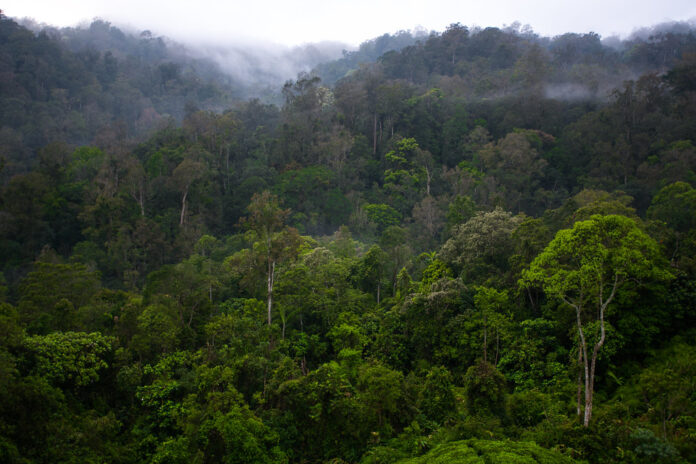
Ecobiz.asia – Indonesia wants to use its newly issued forestry carbon offset regulation to transform the country’s vast forest carbon potential into global carbon market leadership, while opening new financing pathways for sustainable forestry, conservation, and community-based forest management, senior forestry officials said.
During a discussion held in Jakarta on Wednesday (April 29, 2026), Edo Mahendra, Principal Advisor to the Minister of Forestry, said Minister of Forestry Regulation No. 6/2026 on carbon trading through greenhouse gas emission offsets in the forestry sector should be seen as part of Indonesia’s wider effort to build a carbon ecosystem, not merely as a mechanism for selling carbon credits.
“We have always said that we have the greatest potential, the largest endowment, and so on. But how do we realize it? Can we become a carbon superpower?” Edo said during the launch of the regulation.
“With this Ministerial Regulation, we hope Indonesia can finally realize its immense potential to become a global leader, achieve our national targets, and contribute to the fight against the climate crisis together with other countries. But this time, we will lead,” Edo added.
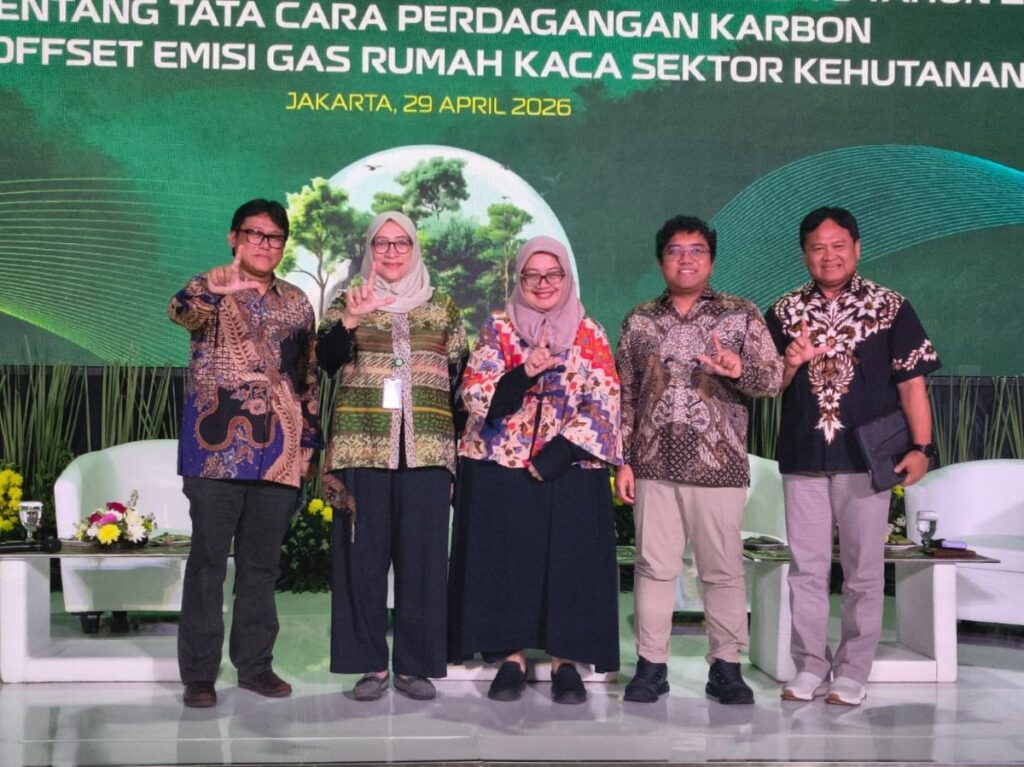
The regulation is an implementing rule under Presidential Regulation No. 110/2025 on Carbon Economic Value and National Greenhouse Gas Emission Control. Edo described Permenhut No. 6/2026 as one of the first implementing regulations under the presidential regulation, with more rules expected from the Ministry of Forestry and other ministries.
“Permenhut 6 is a derivative regulation, perhaps one of the first of many to come, from the Ministry of Forestry and other ministries, including the Ministry of Environment and the Ministry of Energy and Mineral Resources, as implementing regulations of Presidential Regulation No. 110/2025,” Edo said.
He said the spirit of the new carbon economic value framework is built around three main principles: synergy, deregulation, and decentralization. The first principle is aimed at aligning Indonesia’s environmental ambitions with broader development goals, while deregulation is intended to make participation in carbon-related activities simpler for government, private companies, communities, and other actors.
“The first point is the importance of ensuring synergy. Synergy between our environmental target aspirations and our broader development aspirations,” he said.
“The second point is the spirit of deregulation. This is important because we want to ensure that business processes for every element in Indonesia, from the government and private sector to communities and indigenous communities, can be carried out as simply as possible,” Edo added.
Edo said deregulation also means openness to various carbon market channels and instruments, including Indonesia’s own carbon certification instrument (SPE) and other non-SPE mechanisms, as long as they move toward higher quality and integrity.
“One of the spirits of deregulation is openness. Our openness to various available pathways, channels, and instruments,” Edo said.
“If it is our own instrument, we must make it easier for our own instrument. We hope that our SPE can be internationally accepted in the future. If people want to work on it, please go ahead. What about non-SPE mechanisms? That is also fine. We open everything. What matters is that we pursue this step by step with high quality and high integrity,” he added.
Edo emphasized that carbon trading should not be treated as the final objective. Instead, he said, it should function as one of several instruments to help Indonesia meet its climate targets and mobilize climate finance.
“The final objective is not to sell, but to build an ecosystem. What ecosystem? A carbon ecosystem. Carbon can be used, and this is an instrument. This is not the endgame,” Edo said.
“This is an instrument so that our environmental target aspirations can be achieved. There are many channels, and do not think of this as a single silver bullet,” he added.
Broader forestry business model
In the same occasion, Director General of Sustainable Forest Management Laksmi Wijayanti reinforced the point, saying carbon credits should be viewed as part of a broader forestry business model rather than a shift away from existing forest utilization activities.
“I want to clarify that carbon credits or carbon units generated from climate change mitigation actions in the forestry sector are also part of the goods and services business model in forestry activities,” Laksmi said.
She said forestry business is now framed under a multi-business forestry model, which seeks to use different forest potentials to generate economic value while maintaining sustainability.
“We utilize all forest potential to obtain value in accordance with the economic value that the forest should have,” she said.
“If asked whether this is a shift, I think it is more accurate to say that this is part of forestry business development. This is not about competition over what the forestry business will be in the future, but part of financing through a market mechanism to reach the right target groups and ensure that our forest utilization is sustainable,” Laksmi added.
Laksmi said Permenhut No. 6/2026 opens five categories of forest areas as potential supply sources for greenhouse gas emission offsets. These include production forests and protected forests already under permits, approvals, or management rights; certain protection and conservation areas not yet under permits; customary forests; private forests; and state forests outside forest areas or other land use areas.
“We see five forest categories that we open as supply for greenhouse gas emission offsets,” she said.
She said the regulation covers two major types of activities: emission reductions by maintaining existing forest cover and preventing deforestation and degradation, and increasing emission absorption capacity through rehabilitation of damaged or critical land and ecosystem restoration.
“The mechanism regulated under this Ministerial Regulation allows these actors to conduct carbon trading through offsets individually or by being consolidated,” Laksmi said.
Laksmi added that the regulation also allows jurisdictional approaches, including at the provincial level through governors based on agreements with contributors within the jurisdiction, or at the national level through the Minister of Forestry.
She said the government would maintain oversight to ensure that carbon trading remains accountable and credible.
“This Ministerial Regulation clearly states that we open a trading mechanism and accept market mechanisms, but the government, especially the Minister of Forestry, remains responsible,” Laksmi said.
“The government is also responsible for ensuring that the trading is accountable, has high integrity, is real, has minimum risk, and that benefit-sharing is closely supervised by the government,” she added.
Laksmi said the ministry is preparing several strategies to support implementation, including open access to information, investment maps, nesting guidelines, cooperation with international carbon standards and registries, methodology development, and assistance for regional governments and communities.
“This is not about trading invisible goods. We will make it clear. There will be investment maps showing where damaged areas need to be rehabilitated through absorption mechanisms, or where emission reductions can be achieved through avoidance. These will be mapped and made open,” she said.
She said the Ministry of Forestry would continue working with international standards and carbon registries even though mutual recognition agreements are no longer required.
“Although mutual recognition agreements are no longer needed, communication will actually become stronger because there must be a good check-and-balance mechanism between both sides,” Laksmi said.
Edo said Indonesia needs to optimize a wide range of climate financing sources, including state budgets, regional budgets, external finance, results-based payments, carbon markets, the Joint Crediting Mechanism, Article 6 mechanisms, and other possible instruments.
“There is the state budget and regional budgets, our internal finance. Then there is external finance, and there are many forms of it, including results-based payments, carbon, many types of carbon mechanisms, JCM, Article 6, and many other potentials,” Edo said.
He also said the government wants to provide clarity, certainty, and stability for actors involved in the carbon ecosystem. These elements, he said, are being developed gradually under the coordination of the carbon economic value steering mechanism, with the Ministry of Forestry taking part in the process.
“In the future, we must be able to provide three things to every actor in this carbon ecosystem. First, clarity. Second, certainty. Third, stability,” Edo said.
“This is being arranged one by one under the coordination of the steering committee, of which the Ministry of Forestry is also a part,” he added.
Social Forestry
From the social forestry side, Director General of Social Forestry Catur Endah Prasetiani said social forestry groups could participate in carbon trading, but they would need partners because of capacity, technical, and financing limitations.
“Social forestry groups can act as business actors, but there is one main requirement, namely with partners,” she said.
“Why with partners? Because there are limitations in capacity building, technical capacity, and also budget,” she added.
She said the ministry is preparing a revision of Ministerial Regulation No. 9/2021 to regulate who can become partners in social forestry carbon trading. She also said the social forestry program already has an Integrated Area Development approach that is aligned with the nesting concept.
“In social forestry, we already have a policy to increase economic scale through Integrated Area Development, which is an integrated landscape-based planning approach at the regency level. This is aligned with the nesting concept,” she said.
She said around 76 regencies and cities are already at the Integrated Area Development initiation stage, with 30 of them already determined.
In conservation areas, Director of Environmental Services Nunu Anugrah said carbon offsets could help support conservation financing, especially as protected and conservation areas face funding gaps.
“There is potential that we must develop. Previously, there was no carbon commodity in conservation areas. This adds one,” Nunu said in the same occasion.
He said carbon mechanisms could support restoration in areas affected by encroachment, fragmentation, and deforestation, while opening room for public participation and investment.
“For example, in countering encroachment, there is damage, fragmentation, and deforestation. This is an opportunity that can involve public participation and investment in restoration,” he said.
Nunu said conservation areas have about 1.2 million hectares of open areas. Of that amount, around 239,000 hectares are considered clear and clean, while around 983,000 hectares remain affected by conflict.
“The open area we calculated is 1.2 million hectares. The clear and clean area is 239,000 hectares. That means 983,000 hectares are, in quotation marks, still in conflict,” Nunu said.
He added that some investors are also interested in conflict areas because restoration and conflict resolution can increase conservation value.
“Even conflict areas are also interesting for investors. They are also willing to enter, because resolving conflict can at the same time add value or quality to our conservation areas,” he said.
Nunu also pointed to a funding gap in conservation management. He said funding needs from 2021 to 2025 reached Rp11.4 trillion, while the state budget only covered Rp7.8 trillion.
“There is a funding gap of 30 percent. From 2021 to 2025, the need was Rp11.4 trillion, while the state budget was only Rp7.8 trillion,” Nunu said.
“So the spirit is, let us create financing for conservation funding,” he added.
Permenhut No. 6/2026 comes as Indonesia seeks to strengthen the role of the forestry sector in climate mitigation while opening new financing pathways for conservation, restoration, social forestry, and emission reduction activities. Edo said each sector must have agency, ownership, and responsibility in achieving Indonesia’s environmental targets.
“Each sector must have agency and ownership, which also comes with responsibility for achieving their respective targets,” he said.
“The spirit of Presidential Regulation No. 110 is to open all potential climate financing channels that Indonesia can optimize. Therefore, there needs to be shared responsibility from every sector, so that we can work on this together,” he added.
Edo said Indonesia’s carbon opportunity should be developed through a step-by-step process rather than a sudden leap, with the government focusing on building a credible ecosystem that can support national climate targets while positioning the country as a global player in carbon markets. ***