
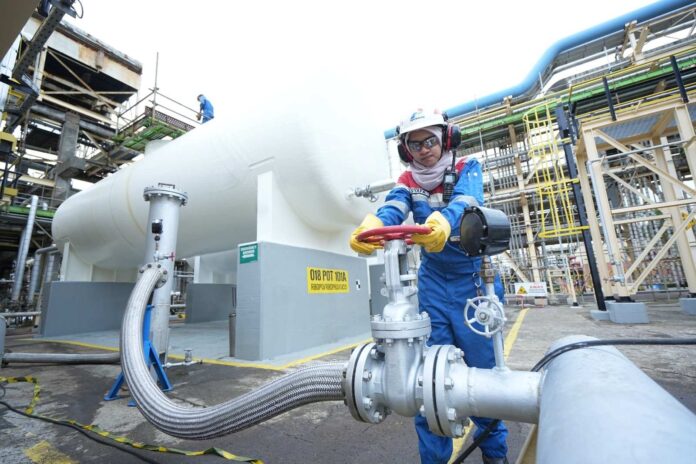
Ecobiz.asia — PT Pertamina is accelerating its entry into the international market by developing a globally certified sustainable aviation fuel (SAF) ecosystem, positioning Indonesia as a competitive waste-based SAF producer for Europe and the Asia-Pacific region.
The initiative is aimed at supporting aviation sector decarbonisation while strengthening Indonesia’s role in the global low-carbon fuel supply chain.
The commitment was outlined by Pertamina’s Director of Transformation and Business Sustainability Agung Wicaksono during an international panel discussion, “Behind the Blend: The Producers Making Net-Zero Aviation Possible,” at the ISCC Global Sustainability Conference 2026 in Brussels.
At the forum, Pertamina shared the stage with global SAF producers including Neste, EcoCeres, and Montana Renewables.
Agung said Pertamina’s participation signalled Indonesia’s readiness to act not merely as a market, but as part of the global solution for aviation decarbonisation.
“Pertamina is representing Indonesia in reducing global aviation emissions through the development of waste-based SAF. We are preparing SAF that is export-ready and competitive in terms of technical specifications, sustainability, and global standards,” Agung said in a statement on Friday (Feb. 27, 2026).
According to Agung, Pertamina’s SAF value chain has been fully certified under the International Sustainability and Carbon Certification (ISCC), covering feedstock collection, refinery processing, storage, and distribution.
The certification ensures full traceability, prevents double counting, and complies with international sustainability and carbon accounting standards.
“Our focus is not merely on producing SAF, but on building a credible, measurable, and globally recognised ecosystem—connecting community-based feedstock collection in Indonesia with international aviation markets,” he said.
Pertamina currently produces SAF through co-processing technology using used cooking oil (UCO) at its Green Refinery in Cilacap, with a blending rate of around 2.4%. Development of the bio-jet fuel began in 2015, including domestic catalyst research and technical testing on Airbus A320-200 aircraft operated by Pelita Air Services.
The company has also established an integrated supply chain, ranging from household and commercial UCO collection to refinery processing and distribution to airlines. All stages meet ISCC standards as a prerequisite for accessing global markets.
“We have completed technical validation across various aircraft types. Pelita Air has even used SAF for domestic and international flights, demonstrating end-to-end operational readiness within our own ecosystem,” Agung said.
Looking ahead, Pertamina plans to scale up production through the Cilacap Biorefinery Phase 2 project, targeted to come on stream in 2029. The expansion is expected to support Indonesia’s mandatory 1% SAF blending policy for international flights starting in 2027, while also opening export opportunities to the Asia-Pacific and European markets.
Agung noted that the main global challenge in SAF development is no longer technology, but the availability of sustainable feedstock.
Indonesia, he said, holds a competitive advantage through waste resources such as UCO and palm oil mill effluent (POME) residues, which can be developed without competing with food production, provided they are managed under strict sustainability and certification principles. ***