

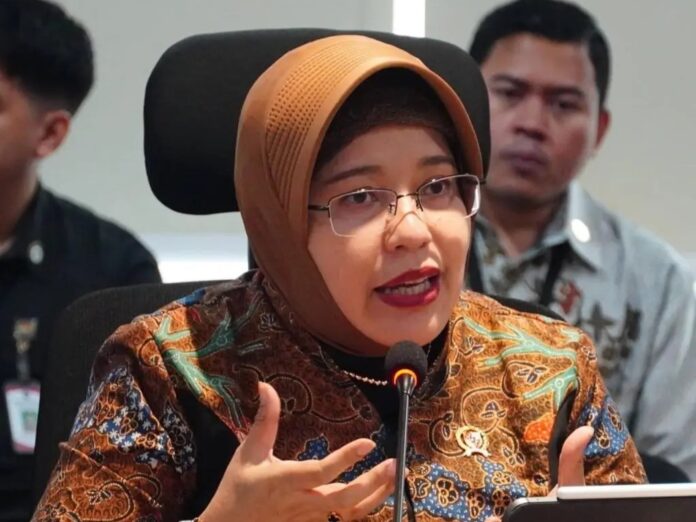
Ecobiz.asia — Statistics Indonesia (BPS) has officially released the 2025 Indonesian Standard Industrial Classification (KBLI), updating the previous 2020 version to keep the country’s economic data framework aligned with global developments, including digital transformation, climate change mitigation, and the rapid growth of carbon-related businesses.
KBLI serves as the national standard for classifying all economic activities in Indonesia based on shared characteristics. It is widely used as a reference for economic analysis, policy formulation, business licensing, and the production of official national statistics.
BPS Head Amalia Adininggar Widyasanti said KBLI 2025 was developed in line with the International Standard Industrial Classification of All Economic Activities (ISIC) Revision 5, recommended by the United Nations Statistical Commission (UNSC) on March 11, 2024. ISIC Revision 5 has already been adopted by several jurisdictions, including the European Union and Singapore.
“Through this release, we introduce KBLI 2025, which refers to ISIC Revision 5. This update is crucial to ensure that Indonesia’s industrial classification remains relevant to evolving economic conditions, technological advances, and new business models, while maintaining international comparability,” Amalia said at a press conference in Jakarta on Friday (Dec. 19, 2025).
BPS noted that KBLI is updated every five years in accordance with recommendations from the Committee of Experts on International Statistical Classification (CEISC). The drafting process for KBLI 2025 involved broad cross-sector participation, with 1,164 proposals submitted by 30 ministries and government agencies.
KBLI 2025 accommodates a range of emerging economic activities that were not previously covered, including digital platform intermediation services, factoryless goods producers (FGP), digital content and creative media activities such as podcasts, gaming, and streaming, as well as carbon trading, capture, and storage activities. Classifications related to renewable energy and financial services have also been expanded.
Structurally, KBLI 2025 adds one new category, bringing the total to 22 categories (A–V), up from 21 categories in KBLI 2020. Overall, the updated classification comprises 87 divisions, 257 groups, 519 classes, and 1,560 business categories.
BPS said KBLI 2025 will serve as the main reference for a wide range of statistical activities, including the 2026 Economic Census, updates to the Statistical Business Register (SBR), and other official statistics produced by the agency.
Beyond statistics, KBLI is also used across policy domains. In the financial sector, it underpins sector classification in integrated commercial bank reporting and Indonesia’s Sustainable Finance Taxonomy. In industry, KBLI is applied through the National Industrial Information System (SIINas), while in business licensing it forms the basis for permits issued via the Online Single Submission (OSS) system.
With the update, BPS expects KBLI 2025 to strengthen Indonesia’s economic data foundation, particularly in capturing activities linked to climate change mitigation efforts and the development of the carbon economy. ***