

ASEAN Common Carbon Framework Pushes Cross-Border Carbon Market Integration

MORE ARTICLES

Ecobiz.asia — The ASEAN Common Carbon Framework (ACCF) is accelerating efforts to build interoperable and high-integrity carbon markets across Southeast Asia, as regional industry associations push for practical implementation and stronger cross-border market integration.

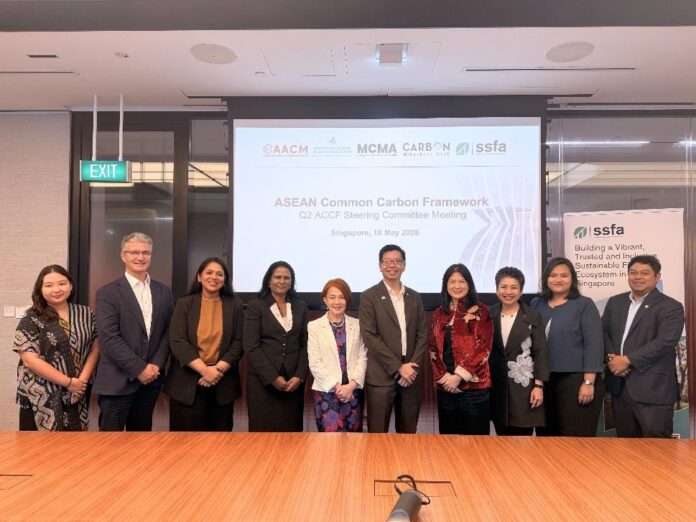
According to a press release received on Monday (May 18, 2026), ACCF member associations convened in Singapore during Ecosperity Week 2026 for the ACCF Steering Committee meeting to advance regional coordination on carbon market development.

The ACCF is an industry-led initiative aimed at supporting the development of integrated and interoperable carbon markets across ASEAN. The framework focuses on three key pillars: supply and demand development, market infrastructure, and strategic communications and capacity building, supported by policy alignment and pilot carbon transactions.

Read also:  PLN Reports Hydrogen Surplus, Ready to Supply Future Mobility

Developed jointly by the Indonesia Carbon Trade Association (IDCTA), Malaysia Carbon Market Association (MCMA), Singapore Sustainable Finance Association (SSFA), ASEAN Alliance on Carbon Markets (AACM), and Thailand Carbon Markets Club (TCMC), the framework has gained increasing regional recognition over the past year.

The Indonesia Carbon Trade Association (IDCTA) highlighted ongoing efforts to strengthen project development and market infrastructure, including feasibility studies on transition credits linked to the early retirement of coal-fired power plants and progress in carbon capture and storage (CCS) initiatives.

Read also:  PLN Expands EV Charging Network as Home Chargers Surpass 92,000

IDCTA also continues to facilitate market dialogues and international collaboration to support carbon project pipelines, pilot transactions, and cross-border cooperation aimed at scaling the supply of high-integrity carbon credits from the region.

Meanwhile, the Singapore Sustainable Finance Association (SSFA) has developed an “Implementation Guide for Corporate Usage of High-Integrity Carbon Credits,” aligned with Singapore’s national guidance and international frameworks to support consistent carbon market practices across ASEAN.

The Malaysia Carbon Market Association (MCMA) has also supported the development of Malaysia’s National Carbon Market Policy, launched in April 2026, which recognizes the ACCF as a key enabler of regional interoperability.

Read also:  Indonesia Looks to Universities to Unlock White Hydrogen Potential

The Thailand Carbon Markets Club (TCMC) has supported early progress in cross-border market connectivity through its collaboration with the Macao Emission Exchange (MEX), including the first listing of Thai Renewable Energy Certificates (RECs) and T-VER carbon credits on an international platform.

According to the press release, the region’s carbon market architecture is evolving toward interoperability rather than uniformity, enabling different national systems to connect in a credible and efficient manner.

Looking ahead, the framework will continue prioritizing pilot transactions, policy harmonization, and capacity building to strengthen trust in ASEAN-origin carbon credits and facilitate broader cross-border collaboration. ***

LATEST STORIES

MORE ARTICLES

Indonesia Links Transport Decarbonization to Energy Security, Rolls Out Zero ODOL Roadmap

Ecobiz.asia - Indonesia is positioning transport decarbonization as a key pillar of its energy security strategy while rolling out a nine-point roadmap to eliminate...

PLN Expands EV Charging Network as Home Chargers Surpass 92,000

Ecobiz.asia – Indonesia's state-owned electricity company PT PLN (Persero) has significantly expanded the country's electric vehicle (EV) charging infrastructure, with the number of home...

Danantara Issues Conditional Letters of Award to Eight Partners for Indonesia’s Second-Phase WTE Projects

Ecobiz.asia - PT Danantara Investment Management (DIM) has officially issued Conditional Letters of Award (CLoA) to eight selected consortiums for the second phase of...

Indonesia Looks to Universities to Unlock White Hydrogen Potential

Ecobiz.asia – Indonesia's Deputy Minister of Higher Education, Science and Technology, Stella Christie, has called on universities to take a leading role in developing...

JICA Survey Maps Indonesia’s Hydrogen Value Chain, Identifies Key Commercialization Barriers

Ecobiz.asia - A comprehensive study by the Japan International Cooperation Agency (JICA) has mapped Indonesia's potential hydrogen and ammonia value chains while identifying major...

TOP STORIES

Dairi Prima Mineral Targetkan Konstruksi Tambang Bawah Tanah Dimulai Kuartal I-2027

Ecobiz.asia -- PT Dairi Prima Mineral (DPM) menargetkan memulai konstruksi proyek tambang bawah tanah timah hitam (Pb) dan seng (Zn) di Kabupaten Dairi, Sumatera...

Agincourt Resources Pertahankan Investasi Pendidikan Rp5,29 Miliar di Tengah Pemulihan Operasi

Ecobiz.asia -- PT Agincourt Resources (PTAR) tetap mempertahankan komitmennya dalam pengembangan sumber daya manusia melalui Program Beasiswa Martabe Prestasi 2026, meski perusahaan masih berada...

PLN pilots calliandra-sorghum biomass project with ITERA to support hydrogen production

Ecobiz.asia -- State electricity firm PT PLN (Persero) has launched a pilot project to develop an integrated biomass and green hydrogen ecosystem by cultivating...

Gerak Hijau 2026 Dorong Kolaborasi Pemerintah, Dunia Usaha dan Masyarakat, ANTAM Pamerkan Capaian Dekarbonisasi

Ecobiz.asia -- Upaya mewujudkan pembangunan berkelanjutan membutuhkan keterlibatan seluruh elemen bangsa. Pesan tersebut mengemuka dalam penyelenggaraan Gerak Hijau 2026 di kawasan Car Free Day...

Pertamina Perkuat Budaya HSSE untuk Jaga Keandalan Operasi dan Ketahanan Energi

Ecobiz.asia – PT Pertamina (Persero) memperkuat implementasi Health, Safety, Security, and Environment (HSSE) sebagai fondasi menjaga keandalan operasional di tengah pertumbuhan bisnis dan meningkatnya...