

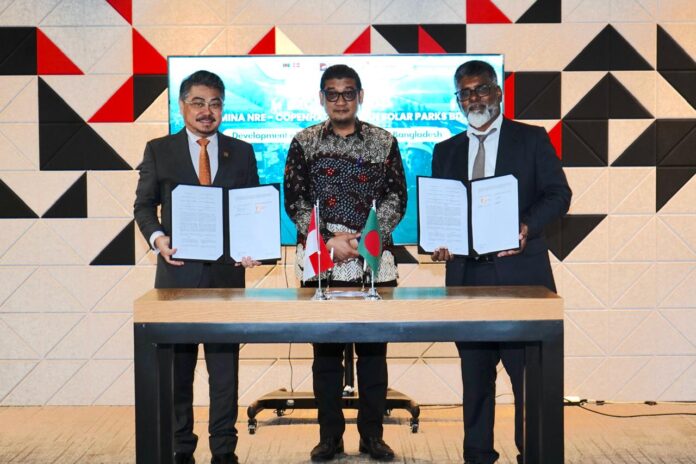
Ecobiz.asia — Pertamina New & Renewable Energy is expanding its renewable energy business into Bangladesh following the company’s large-scale solar energy development success in the Philippines.
The expansion was marked by the signing of a memorandum of understanding (MoU) with Copenhagen Urban Solar Parks BD Ltd (CUSP) to explore solar power development projects in Bangladesh.
The agreement was signed at Grha Pertamina in Jakarta by Pertamina NRE President Director John Anis and CUSP Chairman Ziaur Rahman.
The cooperation covers potential development of solar power plants, including opportunities for operation and maintenance (O&M) partnerships in Bangladesh.
John Anis said the Bangladesh initiative forms part of Pertamina NRE’s strategy to expand its green energy portfolio in international markets after recording positive growth in the Philippines.
“Pertamina NRE currently has more than 1 GWp of installed capacity in the Philippines and continues to grow, targeting 2.6 GWp by the end of this year. This achievement provides an important foundation for developing similar projects in Bangladesh,” John said in a statement on Monday (May 18, 2026).
According to him, the collaboration also comes at a strategic moment amid rising global demand for clean energy and accelerating energy transition efforts.
Under the MoU, the two companies will conduct feasibility studies covering technical, market, business, environmental, legal, and project risk aspects. The partnership will also explore strategic, technical, and commercial cooperation, including technology exchange and renewable energy development expertise.
Ziaur Rahman said the partnership with Pertamina NRE would open broader opportunities for solar energy development in Bangladesh.
“We welcome this collaboration as a strategic step to deliver innovative and efficient clean energy solutions that support sustainable development in Bangladesh,” Ziaur said.
Through the partnership, Pertamina NRE and CUSP aim to accelerate clean energy development, strengthen energy security in both countries, and support Indonesia’s net-zero emissions target by 2060 through green investment and renewable energy technology transfer.
Indonesia’s Foreign Ministry Director for Investment and Creative Economy, Roy Wahab, who attended the signing ceremony, expressed appreciation for the strengthening of economic and energy cooperation between Indonesia and Bangladesh through green investment and sustainable energy development. ***