

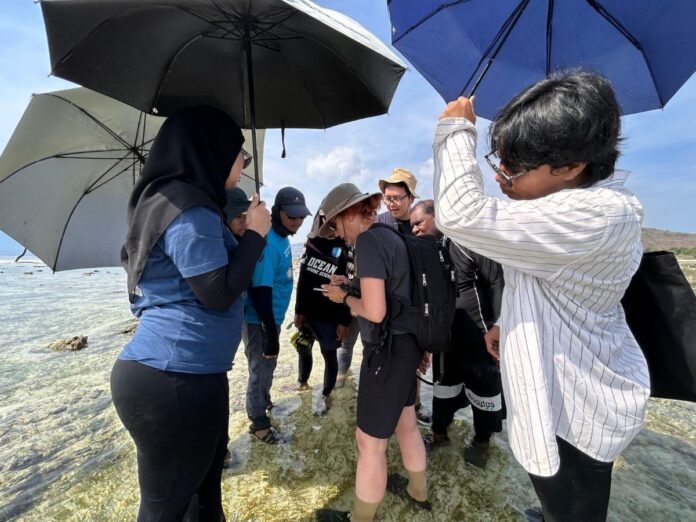
Ecobiz.asia – Kuva Space has partnered with WWF-Indonesia to deploy hyperspectral satellite imaging and artificial intelligence to monitor Indonesia’s mangrove and seagrass ecosystems, aiming to strengthen blue carbon verification and unlock sustainable financing opportunities.
The collaboration will map priority restoration areas in East Nusa Tenggara and East Kalimantan, providing what the organisations describe as a scalable, science-based approach to coastal conservation and blue carbon accounting.
The project is expected to generate datasets that support policy planning, valuation, and integration into global carbon frameworks.
Augustinus Frumentius Harudabawur, head of the Alor Marine Protected Area Management Unit, said the partnership will help local authorities strengthen ecosystem monitoring.
“Hyperspectral monitoring technology can provide significant improvement in monitoring seagrass and mangrove health more accurately, efficiently, and more sustainably,” he said, adding that the initiative could also open opportunities for blue-finance mechanisms benefiting coastal communities.
Blue carbon markets (focused on mangroves, seagrasses and other coastal ecosystems) are expanding as governments and investors look to their climate-mitigation potential.
Although such projects account for less than 1% of credit issuance in the voluntary carbon market, advances in remote sensing and monitoring tools are improving transparency and verification, which are critical for attracting larger volumes of sustainable finance.
WWF-Indonesia said the use of satellite and AI tools reflects how innovation can support environmental stewardship. “By combining AI-based analytics with field data, we can track mangrove and seagrass more accurately and cost-effectively than ever before,” said Imam Musthofa Zainudin, the organisation’s marine and fisheries programme director.
He said stronger monitoring systems could lay the groundwork for verified blue carbon credits that deliver direct benefits to local people.
Kuva Space said hyperspectral imaging captures biochemical and spectral signatures that cannot be detected by conventional satellites, enabling insights into species distribution, biomass, water quality and carbon sequestration.
CEO Jarkko Antila said the technology can help address transparency challenges and improve access to sustainable financing.
“With novel and innovative spaceborne and AI tools like ours, we can detect, identify, and forecast blue ecosystems with greater accuracy, frequency, and scale,” he said in a statement, Wednesday (Dec. 17, 2025).
Indonesia holds around one-fifth of the world’s mangroves, but only about half remain in good condition, according to the State of the World’s Mangroves 2024 report.
Seagrass ecosystems are under similar pressure from pollution, sedimentation and coastal development. WWF-Indonesia and Kuva Space said their collaboration will provide cost-effective, verifiable monitoring to support Indonesia’s blue carbon market and contribute to national climate targets, including the country’s second NDC and FOLU Net Sink strategy.
The initiative also supports priority programmes of Indonesia’s Ministry of Marine Affairs and Fisheries and the East Nusa Tenggara provincial government to improve monitoring and management of blue carbon ecosystems. ***