

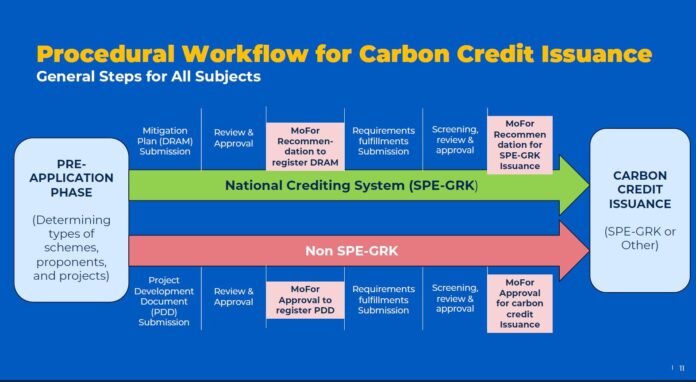
Ecobiz.asia — Indonesia’s Ministry of Forestry has confirmed that forest carbon credits can now be issued through two distinct issuance workflows: the national Greenhouse Gas Emission Trading System (SPE-GRK) and a non–SPE-GRK workflow for projects using international standards.
Both workflows require ministerial approval to ensure projects meet integrity requirements before credits are issued.
The clarification was delivered by Laksmi Wijayanti, Director General of Sustainable Forest Management at the Ministry of Forestry, during the Global Carbon Summit Indonesia 2025 hosted by Ecobiz Asia on Nov. 26–27.
Laksmi said all forest-sector projects must go through a pre-application stage, subject-eligibility checks, submission of a project design document (PDD), verification of requirements, and final approval for carbon credit issuance from the forestry minister.
“There are two issuance workflows — SPE-GRK and non–SPE-GRK. Both still require ministerial approval to guarantee high-integrity processes and outcomes,” she said.
Under the SPE-GRK workflow, projects follow a fully integrated national system, from mitigation plan registration (DRAM) to recommendations for PDD registration and the eventual issuance of credits by the ministry.
The non–SPE-GRK workflow applies to projects issuing credits under international standards such as Verra, Gold Standard or Plan Vivo. These projects must still obtain ministerial recommendations before registry submission and again before the issuance of credits.
She noted that only three groups may serve as project subjects: social forestry permit holders — including customary forests — industrial or natural forest concession holders, and project developers partnering with the ministry in conservation areas. Forest Management Units (KPH) are not yet eligible due to pending legal frameworks.
Laksmi said the dual workflows are tied to Indonesia’s broader forest-sector policy agenda, which positions forestry as a pillar of green growth. The government aims to finance the rehabilitation of 12 million hectares of degraded land and safeguard 49 million hectares of forests from deforestation and degradation.
Because of this, carbon incentives and regulatory benefits “must go to the right subjects,” she said, ensuring that the economic value of carbon reaches forest managers and local communities.
Addressing the summit, Laksmi underscored integrity as the foundation of Indonesia’s forest carbon architecture. Projects must meet internationally recognized principles for credibility, apply robust MRV systems, demonstrate fair benefit sharing with local communities, and incorporate biodiversity protection.
The government also requires social safeguards, grievance mechanisms and environmental risk mitigation as part of every forest-carbon project.
She said the ministry’s involvement across all stages — from pre-application to issuance — is designed to reduce uncertainty, shorten processing time and lower project costs without compromising quality. The approach also prevents mismatches between forestry permitting frameworks and voluntary carbon market mechanisms, which have historically caused jurisdictional disputes and overlapping claims.
Laksmi added that expanding access to carbon markets strengthens Indonesia’s carbon ecosystem, improves data accuracy, raises validation and verification standards, and opens space for methodological innovation. Indonesia continues to recognize international standards to maintain integrity while using the process to accelerate national capacity building.
She concluded by emphasizing that carbon mechanisms must support forest protection, emission reduction and the welfare of indigenous and vulnerable communities. “Carbon instruments must reach the right beneficiaries. The government is here to ensure those who protect the forests receive the benefits,” she said.
Indonesia’s carbon-governance framework is regulated under Presidential Regulation No. 110/2025 on carbon economic value. The Ministry of Forestry is currently aligning key regulations, including revisions to the forestry carbon trading rule (Ministerial Regulation 7/2023), forest planning (Regulation 8/2021), social forestry (Regulation 9/2021), and new rules for ecosystem services in conservation areas. ***