

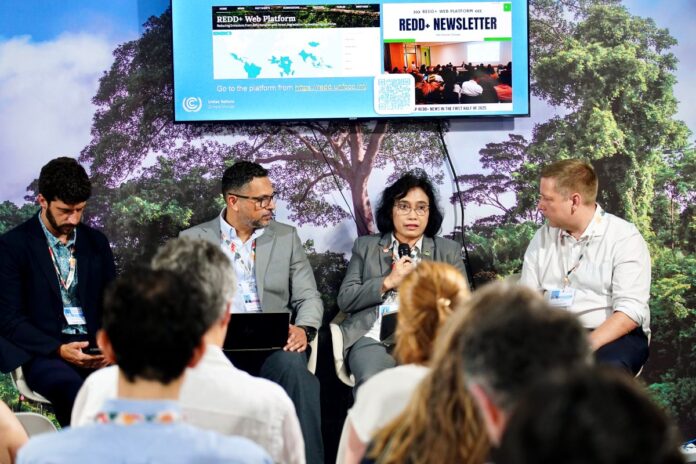
Ecobiz.asia — Indonesia reaffirmed its commitment to strengthening high-integrity, inclusive, and sustainable forest-based financing during a session at the COP30 Forest Pavilion in Belém, Brazil, on Thursday (Nov. 13, 2025).
The statement was delivered by Haruni Krisnawati, Senior Advisor on Climate Change to the Minister of Forestry, during the session Lessons and the Future of REDD+ Results-Based Payments (RBP), organized by the UN-REDD Programme in collaboration with the UNFCCC Secretariat.
Haruni outlined Indonesia’s progress and policy direction in utilizing RBP as a driver of national forest finance. She noted that REDD+ has become a key pillar in strengthening Indonesia’s climate finance architecture.
“The success of REDD+ is not determined solely by technical capacity to calculate emissions, but also by clear governance, data integrity, and strong ownership at both local and national levels,” she said.
She highlighted that Indonesia has received results-based payments from Norway, the Green Climate Fund (GCF), and the World Bank.
According to her, three key lessons emerged from Indonesia’s implementation of REDD+: integrity must begin with transparent national MRV systems; institutional clarity must be ensured through coordination among ministries and the Environmental Fund Management Agency (BPDLH); and policy consistency must be maintained through measures such as the primary forest and peatland moratorium, social forestry, and peatland and mangrove restoration.
Haruni stressed that RBP has strengthened the credibility of Indonesia’s climate policies, particularly in achieving the FOLU Net Sink 2030 target to make the forestry and land-use sector a net carbon sink by 2030.
She added that REDD+ funding managed through BPDLH reinforces Indonesia’s position as a country with accountable and comprehensive climate finance governance.
She also noted that Indonesia’s experience managing RBP became a foundation for developing Presidential Regulation No. 110/2025 on the Carbon Economic Value (NEK), which integrates market and non-market mechanisms under a unified national legal framework.
To enhance the effectiveness of future forest finance, Indonesia has set three priorities: strengthening jurisdictional approaches through provincial nesting; ensuring equity and inclusiveness through benefit-sharing for communities, indigenous peoples, and local governments; and increasing private-sector participation through regulatory certainty under the NEK framework.
The session was attended by speakers from Costa Rica, Guatemala, Uganda, and other global partners, reaffirming Indonesia’s position as a leading country in forest-based climate finance and governance. ***