

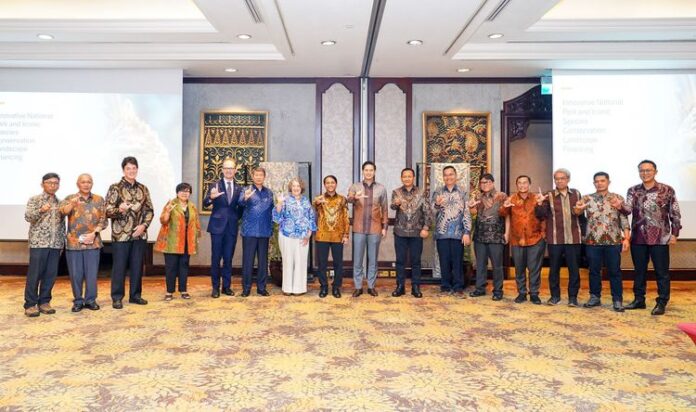
Ecobiz.asia — The UK government has welcomed and supported Indonesia’s establishment of a new task force on innovative financing for national parks and iconic species conservation, marking a strengthened bilateral partnership on biodiversity protection.
The initiative was formalized during a meeting in Jakarta on April 21, 2026, involving senior Indonesian officials and UK representatives, including Ruth Davis and Dominic Jermey.
The task force, established under Indonesia’s Presidential Decree No. 8/2026, is chaired by Hashim Djojohadikusumo, with Forestry Minister Raja Juli Antoni serving as deputy chair.
The UK has committed £2 million to support the initiative, complementing Indonesia’s allocation of $120 million from its state budget for Way Kambas National Park.
Davis said the move demonstrates Indonesia’s growing global leadership in conservation financing and governance.
“This reflects a strong commitment to securing long-term, sustainable funding so national parks can better protect biodiversity, strengthen ranger capacity, and deliver tangible benefits to Indigenous peoples and local communities,” she said in a Forestry Ministry press release, as quoted on Thursday (April 23, 2026)..
She added that the partnership aligns with the UK–Indonesia Strategic Partnership and builds on ongoing collaboration, including the Peusangan Elephant Conservation Initiative. The UK will contribute technical expertise, support the early implementation of high-integrity financing approaches, and help connect Indonesia’s conservation priorities with philanthropic and private sector funding, including through the City of London.
“With strong public governance, clear safeguards, and regulatory reform, this presidential task force has the potential to position Indonesia as a global benchmark in safeguarding critical natural assets,” Davis said.
Indonesia’s Forestry Minister Raja Juli Antoni acknowledged that while the country manages 57 national parks covering 18 million hectares, current conservation funding remains insufficient.
“We must be honest that existing funding is not enough. Our national parks have largely functioned as cost centers, and we need to transform them into more self-sustaining entities,” he said.
To address this, the government has proposed five key reforms, including transforming selected national parks into public service agencies to enable independent financial management, strengthening park management capacity, enhancing the role of the Indonesia Biodiversity Fund managed by the Badan Pengelola Dana Lingkungan Hidup, expanding community participation and benefit-sharing, and improving wildlife corridor protection. ***