
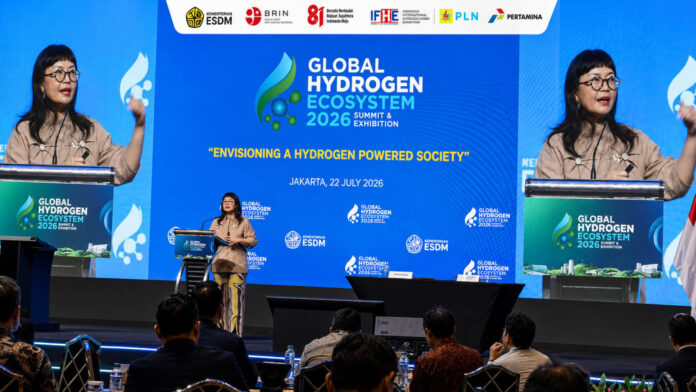
Ecobiz.asia – Indonesia’s Deputy Minister of Higher Education, Science and Technology, Stella Christie, has called on universities to take a leading role in developing the country’s hydrogen ecosystem, arguing that academic institutions must become engines of innovation capable of producing technologies and expertise needed for the emerging industry.
Speaking at the second day of the Global Hydrogen Ecosystem Summit (GHES) 2026 in Jakarta on Wednesday (July 22, 2026) Stella said universities should not limit themselves to education but actively contribute to scientific breakthroughs that support Indonesia’s energy transition.
To illustrate the potential impact of academic research, Stella pointed to last year’s discovery of what has been described as one of the world’s largest natural (white) hydrogen deposits in France’s Moselle region, with an estimated potential value of US$92 billion.
“When we talk about US$92 billion, we rarely imagine that such economic value could be discovered by university researchers. Yet that is exactly what happened,” she said.
Stella noted that the discovery was made by researchers from the GeoRessources Laboratory, a joint research center operated by the University of Lorraine and France’s Centre National de la Recherche Scientifique (CNRS), while they were originally searching for methane.
According to her, the accidental discovery demonstrated how university-based research can generate breakthroughs with major economic implications.
“The economy, energy, and universities should no longer operate separately. We need to build an ecosystem that connects them all,” she said.
Stella explained that white hydrogen—naturally occurring hydrogen formed through geological processes—is increasingly attracting global attention because it offers the prospect of low-emission hydrogen production without the high production costs associated with green hydrogen.
Unlike grey hydrogen, which generates significant carbon emissions, or blue hydrogen, which depends on carbon capture technology, naturally occurring hydrogen could potentially be produced with far lower emissions. While green hydrogen remains the cleanest production pathway, its electrolysis process is still relatively expensive, she added.
“White hydrogen is very attractive because it is economically viable and very clean. The challenge now is how to explore these resources and make them commercially viable,” Stella said.
She added that Indonesia’s geological characteristics suggest the country may also possess significant natural hydrogen resources. Extensive volcanic activity, abundant geothermal systems, and former coal mining areas in Kalimantan and Sumatra share geological features similar to those associated with France’s discovery.
“We have volcanoes, vast geothermal resources, and many former coal mines in Kalimantan and Sumatra with geological characteristics similar to the discovery site in France. Various studies indicate that Indonesia’s potential could be comparable to, or even greater than, France’s,” she said.
Stella said studies conducted over the past three years have identified strong indications of natural hydrogen potential in Indonesia. However, further geological surveys and scientific research will be required to determine the size of the resources and evaluate commercially viable extraction methods.
She emphasized that universities will play a critical role in generating the scientific evidence and technological innovation needed to unlock Indonesia’s natural hydrogen potential while supporting the country’s long-term clean energy ambitions. ***