

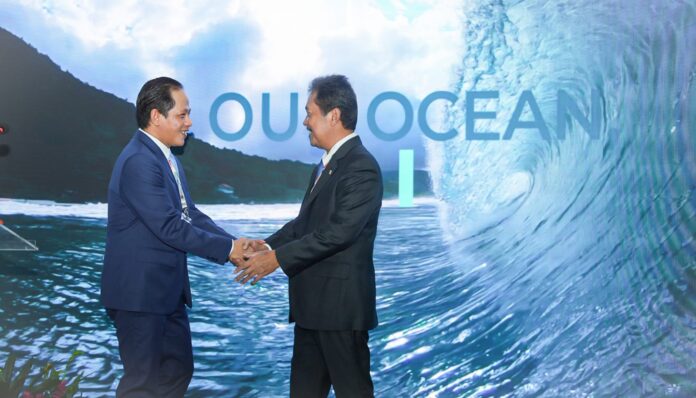
Ecobiz.asia — Indonesia launched its national Blue Carbon Roadmap and Action Guide at the UN Climate Change Conference (COP30), outlining a coordinated strategy to strengthen the role of coastal and marine ecosystems in the country’s climate mitigation and adaptation efforts.
The roadmap, developed by the Ministry of Marine Affairs and Fisheries (KKP), the Ministry of Environment and Environmental Protection Agency (KLH/BPLH), and the Ministry of Forestry with technical support from the Global Green Growth Institute (GGGI) and funding from the Government of Canada, is the country’s first comprehensive framework for managing blue carbon ecosystems.
Indonesia’s Minister of Environment and Head of BPLH, Hanif Faisol Nurofiq, said the new framework marks a shift toward fully integrating blue carbon into the national climate architecture.
“Indonesia aims to ensure that blue carbon becomes a formal part of the country’s carbon economic value system and national carbon market,” he said during the launch event, on Monday (Nov. 17, 2025).
The roadmap aligns with Indonesia’s Second Nationally Determined Contribution (SNDC), which incorporates mangroves, seagrass, and tidal marshes into long-term emission reduction and climate resilience planning. It also supports the country’s FOLU Net Sink 2030 commitment and the implementation of Presidential Regulation No. 110/2025 on the Carbon Economic Value (NEK).
Marine Affairs and Fisheries Minister Sakti Wahyu Trenggono said blue carbon ecosystems are critical assets that support biodiversity, food security and coastal protection.
“This roadmap connects science, policy and financing to strengthen the integrity of blue carbon within the national carbon value system,” he said.
He noted that harmonising the management of the three blue carbon ecosystems under a single coastal–marine approach will enable more effective climate action and unlock sustainable economic opportunities.
Indonesia, home to the world’s largest mangrove area and significant seagrass coverage, is positioning blue carbon as a key pillar of its climate diplomacy and green economy strategy.
The government said the roadmap will guide ministries, local governments, researchers and development partners in scaling up protection and restoration initiatives, including potential integration into high-integrity carbon markets. ***