

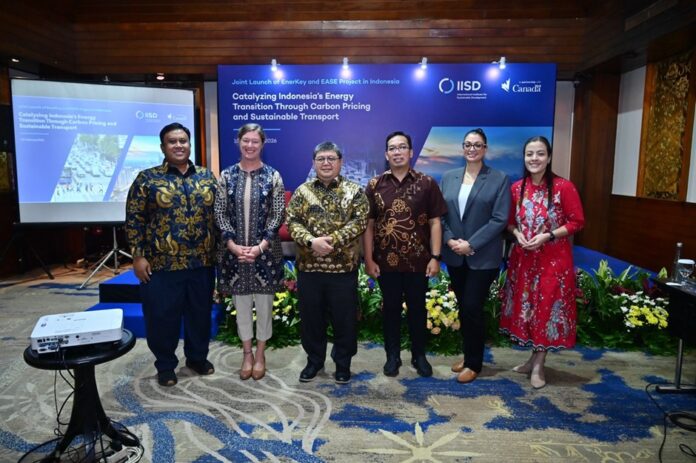
Ecobiz.asia — Indonesia needs stronger alignment between carbon pricing, fiscal policy and energy sector reform to ensure its energy transition delivers effective, credible and socially acceptable decarbonisation outcomes. The issue was highlighted during the joint launch of the Emission Ambitions for Sustainable Economies (EASE) and EnerKey projects, organized by the International Institute for Sustainable Development, on February 10, 2026.
The forum brought together government officials, industry players, academics and civil society organisations to assess Indonesia’s carbon pricing trajectory and broader energy transition agenda.
EASE is an initiative funded by Global Affairs Canada that supports efforts to reduce greenhouse gas emissions in Indonesia, the Philippines and Vietnam. The EnerKey project aims to help mitigate climate change by supporting the decarbonisation of the transport and power sectors in Indonesia and the Philippines.
Francesse Joy Cordon-Navarro, Lead for Carbon Pricing and Philippines Energy Transition at the International Institute for Sustainable Development, said carbon pricing must balance emissions reduction with social protection, competitiveness and policy credibility.
“Reduce emissions while making sure we protect people, competitiveness and credibility,” she said, noting that effective delivery in Indonesia requires alignment across five key dimensions: policy and pricing, energy systems and grids, people and jobs, finance and markets, and public narratives around the transition.
In recent months, the International Institute for Sustainable Development has worked with the Ministry of Energy and Mineral Resources on emissions trading system (ETS) design, including sectoral coverage, emissions reporting and cap-setting. Engagement has also extended to the Ministry of Industry on competitiveness and trade readiness, as well as the National Development Planning Agency (Bappenas) on mapping interactions between fiscal and climate policies.
Knowledge products presented at the event included a review of Canada’s carbon pricing experience, highlighting lessons on governance, revenue use and public acceptance that could be adapted to Indonesia’s institutional context.
A central theme throughout the discussions was the distributional impact of carbon pricing. Participants warned that without credible revenue recycling mechanisms and adequate protection for vulnerable groups, policy acceptance would remain fragile.
“Will this be fair? Can our firms stay competitive? Where will the revenues go?” Cordon-Navarro said, stressing that these questions are not abstract policy debates but practical concerns that will determine the durability of reform.
She added that equity and transparency must be embedded in policy design to ensure both effectiveness and public trust. “These dialogues keep the focus on who pays, who benefits, who may face near-term impacts, and how revenues are recycled,” she said.
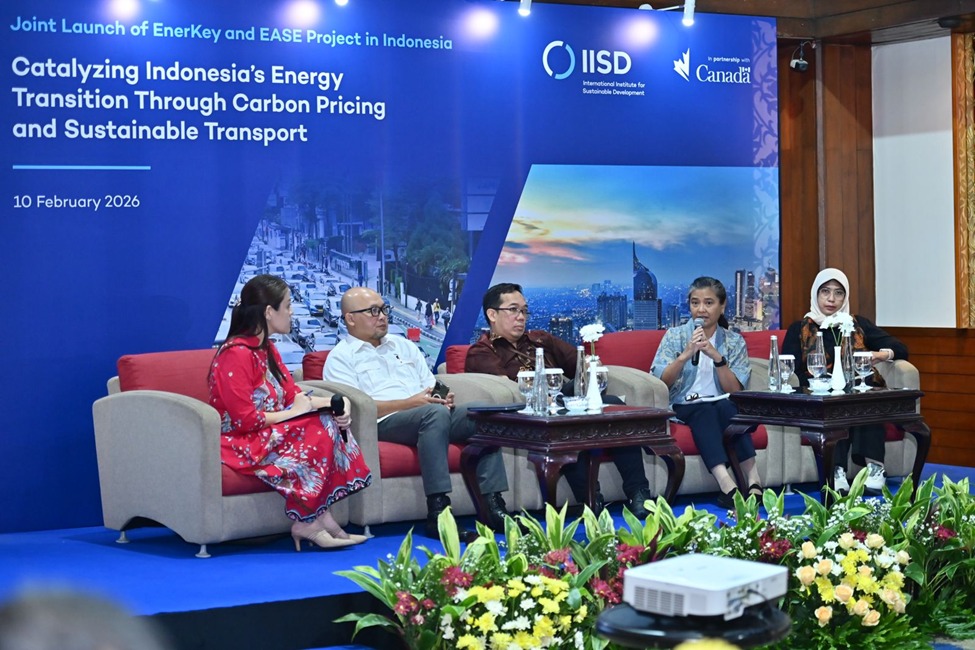
Panel discussions reflected the multi-dimensional nature of Indonesia’s transition challenge, with speakers from government agencies, research institutions and industry addressing ETS implementation in the power sector, affordability concerns and the institutional guardrails needed for a just transition.
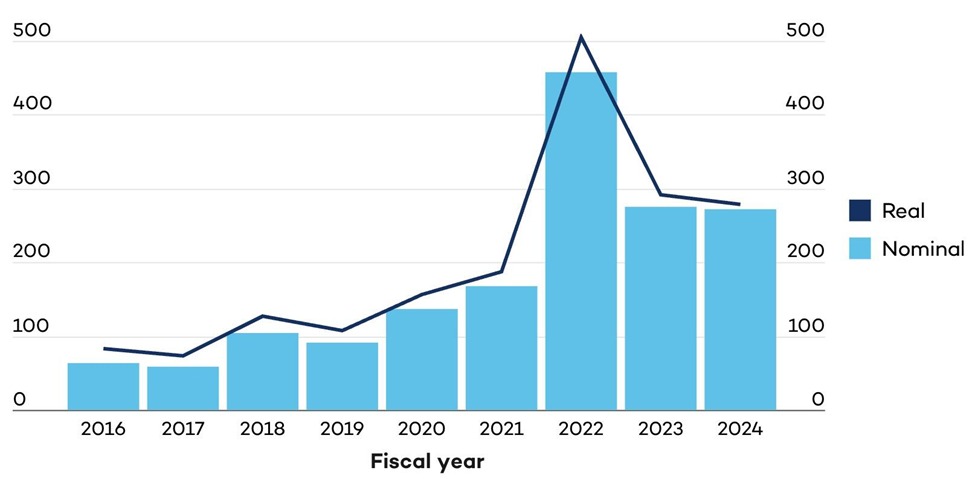
The discussions also highlighted that carbon pricing reform is advancing in a policy environment still heavily shaped by fossil fuel support. Data presented at the launch showed Indonesia allocated IDR 713.5 trillion in energy support in 2024, with nearly 90 percent directed to fossil fuels, while clean energy and electric vehicle incentives amounted to only IDR 10.7 trillion.
Electricity subsidies and compensation reached IDR 176 trillion, equivalent to more than IDR 625,000 per capita annually, while the coal price cap mechanism provided an estimated IDR 58.5 trillion in implicit support.
In the power sector, which underpins Indonesia’s ETS pilot, officials acknowledged that cap-setting, price formation and emissions reporting remain technically and administratively complex, particularly across diverse generation technologies and smaller regional plants. Without stronger measurement systems and better inter-ministerial coordination, market confidence is likely to remain fragile.
Policy volatility was also flagged as a risk, with abrupt changes to electric vehicle incentives and subsidy structures cited as examples of disruptions that have affected industry planning. Economists at the forum stressed that carbon pricing must be accompanied by clear revenue recycling strategies, digital targeting systems for households and alignment with electricity market reform to avoid sending mixed policy signals.
The key takeaway from the discussion was that Indonesia’s challenge lies not in the absence of policy instruments, but in ensuring carbon pricing, subsidy reform and industrial policy move in the same direction. Future progress will depend not only on emissions caps and trading rules, but also on clear revenue recycling pathways, competitiveness safeguards for industry, stronger integration with electricity market reforms and transparent communication to build public trust.
As Anissa Suharsono concluded in a press statement, “Indonesia needs a phased and well-communicated subsidy reform approach. Better targeting of subsidies, a gradual reallocation of public spending toward clean energy, and stronger social protection are key to making this reform work.” ***