

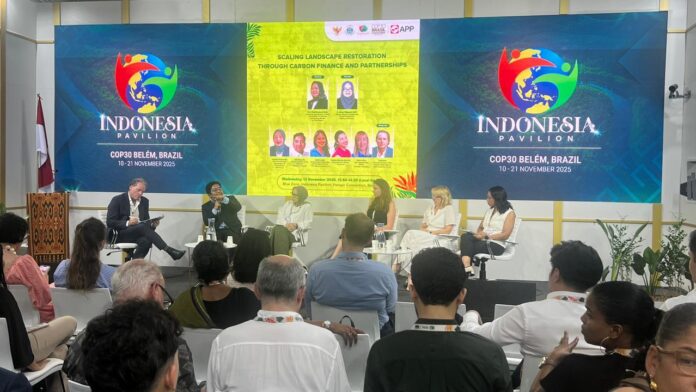
Ecobiz.asia – Indonesia’s efforts to strengthen nature-based climate solutions were highlighted at the COP30 UN Climate Conference in Belém, Brazil, through a high-level dialogue titled “Scaling Landscape Restoration through Carbon Finance and Partnerships” held at the Indonesia Pavilion on Wednesday (Nov. 12, 2025).
The session brought together representatives from government, the financial sector, conservation organisations, and industry to discuss how carbon financing and multi-stakeholder partnerships can accelerate large-scale landscape restoration and support national climate commitments.
Director General of Sustainable Forest Management at the Ministry of Forestry, Laksmi Wijayanti, said in her opening remarks that accelerating restoration requires not only a progressive policy framework but also a strong collaborative ecosystem.
She noted that the Government is preparing an ecosystem restoration concession scheme to provide greater opportunities for the private sector to manage degraded conservation areas over the long term.
Laksmi stressed that policy development must be complemented by innovative financing. “We need collaboration, innovation, and trust. Carbon finance and blended funding can serve as a bridge between global capital and local action,” she said. If implemented with integrity, she added, these mechanisms could restore millions of hectares, support community livelihoods, and strengthen the credibility of nature-based climate solutions.
Moderated by Jack Hurd, Executive Director at the World Economic Forum, the discussion featured Jasmine Prihartini of APP Group, Fairatmos CEO Natalia Rialucky Marsudi, Principal Advisor to the Ministry of Forestry Edo Mahendra, Standard Chartered Chief Sustainability Officer Marisa Drew, and Emily Landis of The Nature Conservancy.
Speakers underlined Indonesia’s strategic position as a global leader in nature-based solutions, with its vast peatlands and mangrove ecosystems central to achieving the FOLU Net Sink 2030 target. They noted that evolving policies—such as the upcoming ecosystem restoration concession scheme and exploration of biodiversity credits—are paving the way for greater restoration and conservation investment.
APP Group, through its Regenesis sustainability platform, outlined how the private sector can utilise carbon markets and data-driven monitoring tools to align commercial objectives with national and global environmental goals.
“Restoration at scale requires both capital and collaboration. Through partnerships with government, NGOs, and local communities, we aim to regenerate critical landscapes while creating long-term social and economic value,” Jasmine Prihartini said.
Standard Chartered’s Marisa Drew highlighted the importance of technology in accelerating financing. She said advancements in carbon measurement and reporting are improving investor confidence and enabling faster financing decisions.
“We need to work together, governments, industries, financial institutions, and technology providers to navigate the complexities of the carbon market. By uniting these strengths, the market can move more quickly and projects can secure funding more easily,” she said. ***