
Ecobiz.asia — The introduction of the Carbon Unit Registry System (SRUK) under Presidential Regulation No. 110/2025 has strengthened Indonesia’s confidence in positioning itself as a global hub for high-integrity carbon markets. SRUK will serve as one of the pillars of transparent, accountable, and internationally aligned carbon transactions.
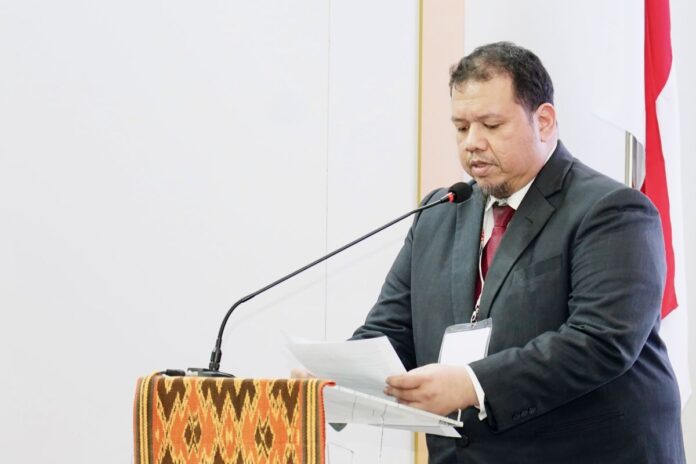
Director of Forest Utilization Business Development at the Ministry of Forestry, Ilham, explained during a keynote speech at the Indonesia Pavilion at COP30 UNFCCC in Belém that SRUK is designed as a national registry managing two instruments simultaneously: allowances and carbon credits.
Unlike the SRN-PPI, SRUK defines allowances as permit-based quotas rather than certificates, while carbon credits remain tradable units.
He added that SRUK is being developed with key features including transparency, full traceability, real-time operations, an immutable permanence system, and decentralized security architecture. Interoperability is also a crucial component, enabling international certificates to be registered in SRUK and connected to Article 6 standards, international registries, and global carbon market platforms.
“SRUK will ensure efficient and credible processes with a clear audit trail. The system is built with institutional governance that supports standardized approval workflows across government agencies,” Ilham said during the session titled “Navigating Indonesia’s Carbon Market: Challenges, Opportunities and the Road Ahead” on Saturday (Nov. 15, 2025).
The panel also featured Lufaldy Ernanda (Otoritas Jasa Keuangan), Andrea Bonzanni (International Emissions Trading Association), Lorna Ritchie (Integrity Council for the Voluntary Carbon Market), Jamey Mulligan (Amazon), and Kei Watanabe (Musi Hutan Persada). The session was moderated by Natalia Rialucky from Fairatmos.
Ilham noted that the strengthening of SRUK runs in parallel with the drafting of ministerial regulations mandated by Presidential Regulation 110/2025 to ensure that forest carbon credits produced in Indonesia meet high-integrity and internationally aligned standards.
He said the draft ministerial regulation is nearing completion, but the ministry continues to invite input from international and domestic stakeholders. “Before the regulation is released, we want all stakeholders, including international partners, to provide feedback,” he added.
According to Ilham, the forthcoming regulation outlines five quality pillars for carbon projects: integrated project design documents (PDD), application of universal principles aligned with international standards, assurance systems to ensure project durability, fair benefit-sharing with communities to prevent social and tenure conflicts, and biodiversity protection as a defining feature that distinguishes high-integrity projects from lower-quality ones.
Ilham emphasized that the regulatory framework and SRUK will shape the future of Indonesia’s carbon market.
“What we are building today is a foundation for the future—one in which forests become economic assets, local communities become central actors, and Indonesia emerges as a hub for global carbon trading,” he said.
He stressed that collaboration across government, the private sector, academia, Indigenous Peoples, local communities, and international partners is essential to ensure that the economic value of carbon becomes not only a market instrument but also a vehicle for sustainability, equity, and shared prosperity. ***