
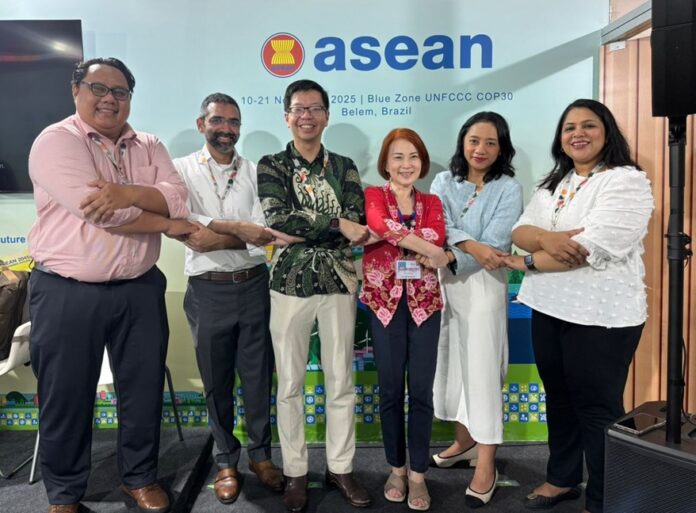
Ecobiz.asia — The ASEAN Common Carbon Framework (ACCF) highlighted its first-year progress and outlined next steps for regional carbon market cooperation during a panel session at the ASEAN Pavilion at COP30 UNFCCC in Belém, Brazil, on Thursday (Nov. 13, 2025).
The panel, titled “ASEAN Common Carbon Framework: Bridging National Priorities with Regional Goals,” brought together industry leaders from the Malaysia Carbon Market Association (MCMA), ASEAN Alliance on Carbon Markets (AACM), and the Singapore Sustainable Finance Association (SSFA). The discussion was moderated by SSFA Director Kavitha Menon.
Dr. Renard Siew, Chair of the ACCF Steering Committee, said the initiative has evolved rapidly since its launch at COP29 under a Memorandum of Collaboration. “In just one year, the ACCF has moved from concept to a structured work plan,” he said. “Our goal is not to impose a unified regime, but to define practical guardrails that support each country’s pathway while strengthening regional coherence.”
The ACCF’s progress has begun receiving formal regional recognition, including mentions in the 57th ASEAN Economic Ministers’ Joint Statement, the ASEAN Joint Statement on Climate Change to COP30, and guidance issued by the ASEAN Capital Markets Forum for the development of a regional voluntary carbon market.
Panel members said the Framework’s next phase will focus on scaling participation among ASEAN member states, testing market interoperability through pilot transactions, and deepening engagement with regulators and sectoral bodies. They also stressed the need to avoid fragmented carbon market rules and ensure alignment with Article 6 of the Paris Agreement.
The ACCF work plan is built around three pillars (Supply and Demand Market Infrastructure, and Strategic Communications and Capacity Building) with regulatory alignment and pilot projects as cross-cutting priorities.
Looking ahead, the Steering Committee plans to explore pathways for regional acknowledgment of ACCF’s principles once stronger track records and trust are established. Leadership continuity beyond the initial two-year Memorandum of Collaboration is also under review, potentially through rotating roles among member associations.
The panel concluded that the ACCF’s success will be measured by the establishment of clear regional guardrails, real-world interoperability pilots, and stronger investment signals capable of channeling finance into high-integrity carbon projects across ASEAN. ***