
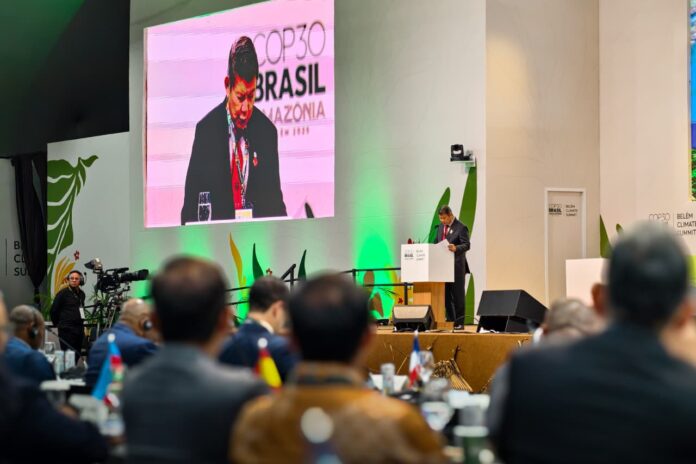
Ecobiz.asia — Indonesia reaffirmed its commitment to strengthening global climate action through a green development strategy that is equitable and people-centered, Special Envoy for Climate and Energy Hashim Djojohadikusumo said at the COP30 Leaders Summit in Belém, Brazil, on Thursday (Nov 6,2025), representing President Prabowo Subianto.
Hashim said Indonesia came to Belém with a clear message, ready to enhance national climate action and work with other countries to deliver inclusive and ambitious solutions.
He was accompanied by Forestry Minister Raja Juli Antoni and Environment Minister Hanif Faisol Nurofiq, underscoring the government’s commitment to integrating forestry and environmental policies in efforts to reduce national emissions.
Hashim reiterated Indonesia’s adherence to the Paris Agreement, targeting net-zero emissions by 2060 or sooner, while maintaining sustainable economic growth of up to 8 percent per year.
The country’s green development strategy is laid out in its Second Nationally Determined Contribution (SNDC), which caps emissions at 1.2–1.5 gigatons of CO₂ equivalent by 2035 and targets a 23 percent share of renewable energy by 2030, including the development of nuclear power as part of a clean energy transition.
He said the forestry and land-use sectors remain the cornerstone of Indonesia’s decarbonization efforts. Through the FOLU Net Sink 2030 program, Indonesia aims to reduce 92–118 million tons of CO₂ by 2030 through deforestation prevention, forest rehabilitation, biodiversity conservation, and protection of peatland and mangrove ecosystems.
Hashim also voiced Indonesia’s full support for the Tropical Forests Forever Facility (TFFF), a USD 125 billion global financing mechanism initiated by Brazilian President Luiz Inácio Lula da Silva to support tropical forest countries.
“Indonesia’s annual deforestation rate has fallen to its lowest level in two decades, down 75 percent since 2019. The government is also strengthening wildlife conservation through elephant corridor development and community-based conservation programs,” he said.
Indonesia emphasized the importance of integrating climate and biodiversity agendas, aligning with the Joint Climate–Nature Declaration of COP28.
Hashim also highlighted the vast potential of Indonesia’s blue carbon ecosystems, which store about 17 percent of the world’s blue carbon — equivalent to 3.4 gigatons of CO₂. The government is committed to protecting and restoring coastal ecosystems to strengthen food security, shoreline protection, and the sustainability of coastal livelihoods.
“Climate action must be fair, inclusive, and people-centered. Indonesia firmly believes that no one should be left behind in the transition toward a green future,” Hashim said.
As part of its concrete actions, President Prabowo has announced the allocation of 1.4 million hectares of customary forests to Indigenous and local communities over the next four years, a major step toward social and ecological justice.
Indonesia attended COP30 as a constructive partner and a driver of global consensus. The summit’s focus on forests, critical minerals, finance, biodiversity, and adaptation aligns closely with Indonesia’s national priorities.
“Indonesia is ready to lead, collaborate, and contribute to global climate action so that together we can build a more resilient world. The era of long negotiations is over, it is time for real action,” Hashim concluded. ***