

Indonesia’s Second NDC Targets Lower Peak Emissions, Minister Hanif Says

MORE ARTICLES

Ecobiz.asia — Indonesia has officially submitted its Second Nationally Determined Contribution (Second NDC) to the UNFCCC, setting more ambitious greenhouse gas (GHG) reduction targets than the previous Enhanced NDC.

Minister of Environment Hanif Faisol Nurofiq said Indonesia’s new climate document introduces an emission target below the 2019 emission level, which now serves as the base year. Under the new approach, Indonesia aims to peak its GHG emissions at 1.3 gigatons CO₂e under the low-emission scenario (LCCP-L) and 1.4 gigatons CO₂e under the high-emission scenario (LCCP-H) by 2030.

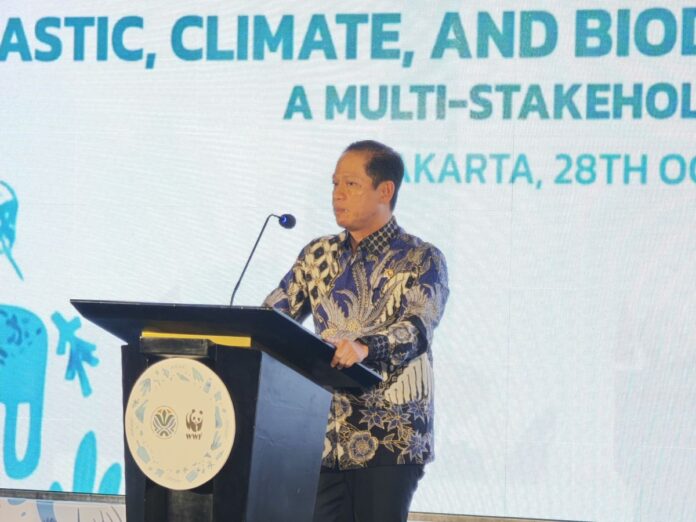
“Compared to the Enhanced NDC, the Second NDC is more ambitious. The figures we submitted to the UNFCCC are higher than those in the previous document,” Hanif said during the Multi-Stakeholder Dialogue: Plastic, Climate and Biodiversity Nexus Forum in Jakarta, Tuesday (Oct. 28, 2025).

Read also:  Indonesia Opens Access to Performance-Based REDD+ Carbon Financing Through ART-TREES

The previous Enhanced NDC projected Indonesia’s peak emissions at 1.9 gigatons CO₂e with domestic efforts (Countermeasure 1) and 1.6 gigatons CO₂e with international support (Countermeasure 2). Based on the new Low Carbon Compatible with the Paris Agreement (LCCP) framework, Indonesia’s target represents an 8–17.5% reduction from the 2030 projections under the Enhanced NDC.

Under the LCCP scenarios, Indonesia is expected to reach peak emissions in 2030 with estimated levels of 1,345,707 Gg CO₂e under LCCP-L and 1,491,474 Gg CO₂e under LCCP-H, before gradually declining by 2035 to 1,257,717 Gg CO₂e (LCCP-L) and 1,488,866 Gg CO₂e (LCCP-H).

Read also:  UK, Indonesia Step Up Cooperation to Protect Sumatran Elephants Under New Strategic Partnership

The emission reduction focus covers five key sectors: energy, waste, agriculture, industrial processes and product use (IPPU), and forestry and other land use (FOLU). The FOLU sector remains the backbone of mitigation, targeting FOLU Net Sink 2030, the restoration of 2 million hectares of peatland, and rehabilitation of 8.3 million hectares of degraded land.

In the energy sector, the government aims for a 19–23% share of renewables by 2030 and 70% by 2060. Implementation is supported by several key regulations, including Government Regulation No. 33/2023 on energy conservation, Presidential Regulation No. 112/2022 on renewable energy acceleration, and Presidential Regulation No. 110/2025 on carbon pricing instruments.

Read also:  Indonesia to Unveil Transport Decarbonisation Roadmap by May 2026

The Second NDC also highlights the integration of mitigation and adaptation efforts through programs such as the Climate Village Program (ProKlim), the strengthening of the National Registry System (SRN) connected to the Indonesia Stock Exchange for carbon trading, and the application of just transition principles to ensure an inclusive and equitable energy transition.

The government estimates a total investment requirement of USD 472.6 billion through 2035 to implement the Second NDC, partly funded through the national budget and managed by the Environmental Fund Management Agency (BPDLH). ***


LATEST STORIES

MORE ARTICLES

Indonesia to Unveil Transport Decarbonisation Roadmap by May 2026

Ecobiz.asia — Indonesia is preparing a national roadmap to decarbonise its transport sector as part of efforts to cut carbon emissions and meet its...

UK, Indonesia Step Up Cooperation to Protect Sumatran Elephants Under New Strategic Partnership

Ecobiz.asia — UK and Indonesia stepped up cooperation to protect biodiversity, local communities and key species such as the endangered Sumatran elephant, as the...

Indonesia’s Carbon Trading Gains Early Traction, Survey Flags Areas for Market Growth

Ecobiz.asia — Indonesia has made notable progress in establishing a formal carbon trading framework, but market participants say further improvements in transparency, regulatory certainty,...

Indonesia Joins Coalition to Grow Carbon Markets, Tapping Experience in Forest-Based Carbon Projects

Ecobiz.asia — Indonesia has joined the Coalition to Grow Carbon Markets, an international initiative aimed at strengthening high-integrity carbon markets and scaling up global...

Veritask: Forestry Regulation No. 27/2025 Sets Rules for Environmental Services Businesses in Conservation Areas

Introduction 1.1 Regulatory Background Minister of Forestry Regulation Number 27 of 2025 on the Utilization of Environmental Services in Nature Reserve Areas, Nature Conservation Areas, and...

TOP STORIES

Gakkum Kehutanan–Satgas PKH Tertibkan Pertambangan Emas Tanpa Izin di Kawasan Hutan Solok Selatan

Ecobiz.asia — Balai Penegakan Hukum (Gakkum) Kehutanan Wilayah Sumatera bersama Satgas Halilintar Penertiban Kawasan Hutan (PKH) menggelar operasi penertiban Pertambangan Emas Tanpa Izin (PETI)...

Sriwijaya Capital Invests Up to US$20 Mil. in SESNA to Expand Solar Power Projects

Ecobiz.asia — Southeast Asia–focused private equity firm Sriwijaya Capital has invested up to US$ 20 million in PT Sumber Energi Surya Nusantara (SESNA), marking...

PDC Perkuat Budaya HSSE, Tekankan Akuntabilitas Pimpinan dan Kepatuhan Pekerja

Ecobiz.asia - PT Patra Drilling Contractor (PDC) memperkuat budaya keselamatan dan kesehatan kerja dengan menempatkan akuntabilitas pimpinan dan kepatuhan pekerja sebagai pilar utama penerapan...

ASEAN Smart Energy & Energy Storage Expo 2026

Ecobiz.asia - Supported by the Ministry of Energy of Thailand, the Electricity Generating Authority of Thailand (EGAT), and the Thailand Convention and Exhibition Bureau...

Indonesia to Unveil Transport Decarbonisation Roadmap by May 2026

Ecobiz.asia — Indonesia is preparing a national roadmap to decarbonise its transport sector as part of efforts to cut carbon emissions and meet its...