

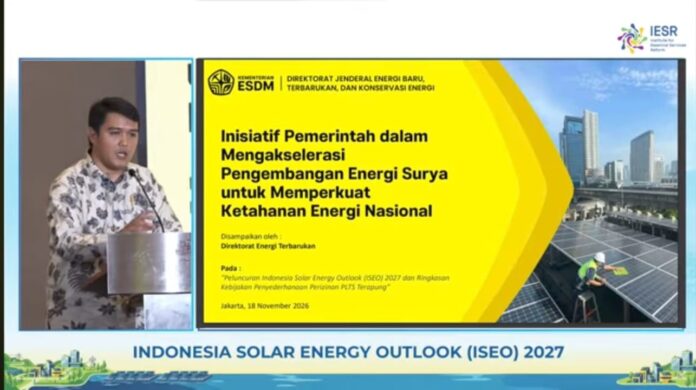
Ecobiz.asia – Indonesia is finalising a draft Presidential Regulation on the development of 100 gigawatt-peak (GWp) of solar power capacity, following the completion of harmonisation with relevant ministries and government agencies.
Erick Ta’dung, coordinator for renewable energy business supervision at the Energy and Mineral Resources Ministry’s Directorate General of New, Renewable Energy and Energy Conservation, said discussions were now focused on finalising the substance of the regulation.
“We have completed the harmonisation process with all ministries and government agencies. The draft is now at the finalisation stage, with discussions focusing on the substance of the provisions under the respective responsibilities of each ministry and agency. We hope it can be issued soon,” he said at the launch of the Indonesia Solar Energy Outlook (ISEO) 2027 and a policy brief on simplifying floating solar power plant licensing, organised by the Institute for Essential Services Reform (IESR) on Wednesday (Nov. 18, 2026).
The regulation is intended to provide a dedicated policy framework for accelerating solar power development. In parallel, the government is discussing revisions to Presidential Regulation No. 112/2022 on accelerating renewable energy development for electricity supply.
Under the proposed revision, provisions on solar power development will be removed from the existing regulation, as they will be covered separately by the planned 100-GWp solar regulation.
Erick said the government had also introduced other policies to support the energy transition, including Government Regulation No. 40/2025 on National Energy Policy, Energy and Mineral Resources Ministerial Regulation No. 10/2025 on energy transition in the electricity sector, and the 2025–2034 Electricity Supply Business Plan (RUPTL) of state-owned utility PLN.
Under the National Electricity General Plan (RUKN), Indonesia’s power generation capacity is projected to reach around 443 gigawatts by 2060. Variable renewable energy sources are expected to account for approximately 42% of that capacity, supported by 34 GW of battery energy storage, while dispatchable power plants will make up the remaining 58%.
A national supergrid is also planned to strengthen electricity system integration and accommodate a larger share of renewable energy. Solar power capacity is projected to reach approximately 109 GW by 2060.
“The figures demonstrate that solar energy will become one of the key components in Indonesia’s electricity system transformation,” Erick said.
In the shorter term, PLN’s 2025–2034 RUPTL targets the addition of 42.5 GW of renewable energy generation capacity and 10.2 GW of energy storage.
The planned projects will be distributed across Java-Madura-Bali, Sumatra, Kalimantan, Sulawesi and other parts of the country.
Erick said the renewable energy and storage programme was estimated to require investment of around Rp1,682.4 trillion. It is also projected to create approximately 760,000 green jobs and reduce greenhouse gas emissions by 129.5 million tonnes of carbon dioxide equivalent (CO2e). ***