
Ecobiz.asia – Indonesia needs to address major barriers in project procurement, regulatory coordination, grid infrastructure and electricity demand to achieve its 100-gigawatt-peak (GWp) solar power ambition, according to the Indonesia Solar Energy Outlook (ISEO) 2027 released by the Institute for Essential Services Reform (IESR).
Indonesia’s installed solar capacity reached 1.59 GWp in the first quarter of 2026, up from 171 megawatt-peak (MWp) in 2020. However, solar power still accounts for only around 1.5% of the country’s total installed generation capacity.
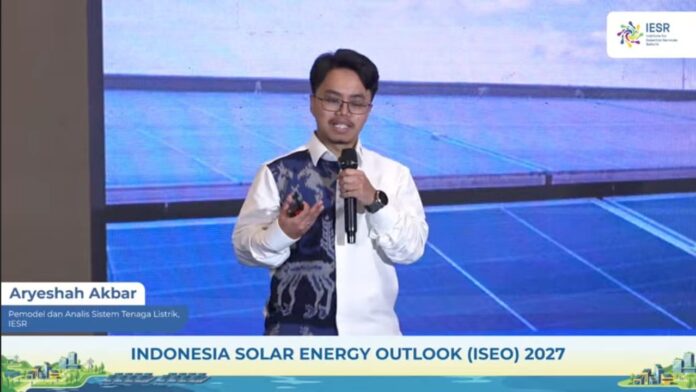
Aryeshah Akbar, a power system modeller at IESR and one of the authors of the Indonesia Solar Energy Outlook (ISEO) 2027, said the government’s 100-GWp programme would require stronger implementation to translate announced projects into operational capacity.
Speaking at the launch of ISEO 2027 and a policy brief on simplifying floating solar permitting on Wednesday (Nov. 18, 2026), he said Indonesia’s reliance on fossil fuels remained high, with coal-fired power plants accounting for more than 67% of electricity supplied to the national power system at the end of 2025.
He said greater solar deployment could strengthen energy security by reducing exposure to volatile fossil fuel prices, as solar power plants have no fuel-related variable costs once operational.
However, several projects under the government’s quick-win programme, announced in August 2026 with a combined capacity of 5.2 GWp to 5.3 GWp, have yet to advance to construction.
Of the announced capacity, only around 526 MWp had identified commercial operation date targets, while approximately 4.2 GWp remained at the ready-for-tender stage and another 441 MWp was under construction.
“The challenge is how to convert the projects that have been announced into financeable and construction-ready projects through efficient tendering processes and certainty regarding land availability and grid connections,” Aryeshah said.
The report also identified constraints in different segments of the solar market. Rooftop solar accounted for around 0.9 GWp, or 57% of Indonesia’s total installed solar capacity, but growth has been constrained by the shift from net metering to a quota-based system.
Utility-scale solar projects face land availability and permitting challenges, while floating solar developments using more than 20% of reservoir areas require more detailed approval procedures.
Captive solar installations, particularly in the nickel smelting industry, are also expected to grow. IESR estimates the segment could add at least 353 MWp over the next one to two years. However, energy-intensive industries operating around the clock will need battery energy storage systems to ensure a continuous power supply.
IESR identified five priorities for accelerating solar development: improving procurement through bundled tenders and greater transparency; expanding electricity demand; strengthening grid infrastructure and storage; developing a more integrated domestic solar manufacturing supply chain; and aligning regulations and electricity planning with the 100-GWp target.
Aryeshah cited PLN’s Mentari Nusantara 1 programme, which bundled 22 solar projects into a single procurement process, as an example of an approach that could improve economies of scale and speed up tendering.
He also said the 100-GWp target needed to be incorporated into the next revision of the Electricity Supply Business Plan (RUPTL). A specific presidential regulation governing the programme was still awaited and was considered an important legal basis for the revision.
IESR’s assessment also found that only around 30% of the projects listed in the 2025–2034 RUPTL had been realised after its first year of implementation. Land availability, permitting and grid connections remained among the main obstacles.
The report further highlighted the need to expand domestic solar manufacturing beyond module assembly. Although Indonesia’s annual solar photovoltaic module manufacturing capacity had reached around 27 GWp, local production of upstream components such as wafers, ingots and polysilicon remained limited.
“Optimism about the 100-GWp target must be accompanied by concrete action. There is still work to be done before solar power can become a backbone of Indonesia’s energy security and sovereignty,” Aryeshah said. ***