
Ecobiz.asia – The ASEAN Common Carbon Framework (ACCF) is seeking a more formal role within ASEAN and closer alignment with global carbon market standards as it moves into a new two-year phase focused on turning regional cooperation into practical outcomes.
The framework’s 2026–2028 strategy includes expanding its membership, strengthening coordination with international carbon market initiatives and establishing an ASEAN Community of Practice to facilitate knowledge-sharing and consultations on longer-term projects.
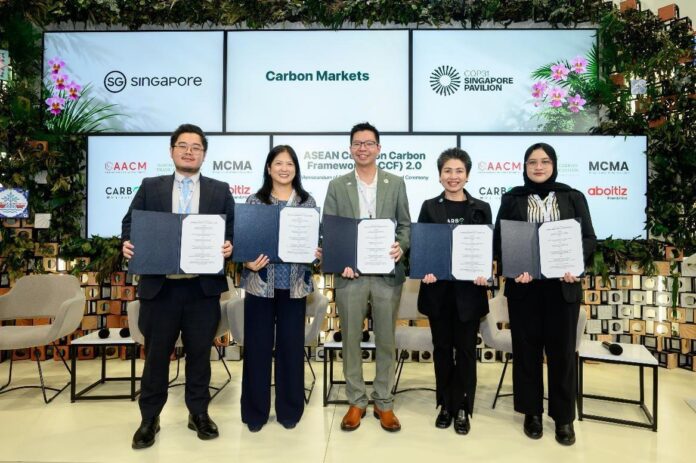
The priorities follow the renewal of the ACCF’s Memorandum of Collaboration at the 31st UN Climate Change Conference (COP31) in Antalya, Türkiye, on Nov. 12, 2026. The five founding signatories extended their cooperation for another two years, while the Philippines-based Aboitiz Foundation Inc. joined as an observer.
The ACCF was established at COP29 in November 2024 to support the development of high-integrity and interoperable carbon markets across Southeast Asia. Its founding members are the Malaysia Carbon Market Association (MCMA), ASEAN Alliance on Carbon Markets (AACM), Singapore Sustainable Finance Association (SSFA), Indonesia Carbon Trade Association (IDCTA) and Thailand Carbon Markets Club (TCMC).
Under the chairmanship of SSFA, which began in the second half of 2026, the ACCF will focus on three areas: strengthening carbon credit supply and demand, improving market infrastructure and building regional capacity.
On the demand side, it plans to develop an interim pathway for corporate use of high-integrity carbon credits and a due diligence framework to help financiers assess carbon project investments. On market infrastructure, it will seek greater clarity on the legal status of verified carbon credits and explore ways to reduce cross-border barriers to harmonisation and the fungibility of credits across ASEAN markets.
The framework will also work with international partners to provide technical and advisory support for carbon finance and bring its work to ASEAN forums.
Oi-Yee Choo, ACCF co-chair, co-lead of SSFA’s Carbon Markets Workstream and chief executive of Climate Impact X, said the organisation would work closely with Singapore as it assumes the ASEAN chairmanship in 2027, complementing regional market-building efforts from the private sector.
The framework also aims to broaden its regional representation through new members, including Aboitiz Foundation, which joined as an observer.
“By plugging in to initiatives such as the Coalition to Grow Carbon Markets, we will also bring ASEAN’s perspective to the global agenda and help ensure carbon markets develop more equitably,” Choo said.
The renewal also marks a step towards aligning ASEAN’s carbon market development with global efforts to promote credible corporate use of carbon credits. All five founding signatories now support the Shared Principles developed by the Coalition to Grow Carbon Markets, a government-led initiative co-chaired by Kenya, Singapore and the United Kingdom.
Launched at the COP30 Business and Finance Forum in November 2025, the principles set out six pillars for companies to use carbon credits credibly alongside deep emissions reductions within their own operations.
Renard Siew, president of MCMA, said the ACCF had originated as a priority deliverable under Malaysia’s ASEAN chairmanship, championed through the ASEAN Business Advisory Council Malaysia to advance regional carbon market cooperation.
He said the next phase should move beyond dialogue towards tangible outcomes that build market confidence, strengthen institutional capacity and unlock cross-border opportunities.
“The ambition should not simply be to grow carbon markets, but to ensure they deliver meaningful climate impact, mobilise investment and create lasting value for the region,” Siew said.
Dharsono Hartono, permanent chair of AACM, said closer coordination, knowledge-sharing and joint efforts to address common challenges would help strengthen confidence in carbon credits originating from ASEAN and create more opportunities for cross-border cooperation.
Riza Suarga, president of IDCTA, said the framework should now translate its commitments into concrete action, particularly by supporting the development and implementation of carbon projects that meet high standards of quality, transparency, credibility and environmental integrity.
Gloyta Nathalang, chair of TCMC, said cooperation between governments and businesses could strengthen credit quality and market interoperability while respecting the different priorities of ASEAN member states. She said TCMC would contribute by sharing knowledge and bringing the practical experience of project developers and buyers into the framework’s work.
Aboitiz Foundation President Ana Margarita Hontiveros said the foundation’s participation as an observer would allow it to share experience and learn from regional partners, representing the Philippines’ nature-based solutions industry and carbon coalition groups.
She said regional carbon market cooperation should deliver benefits beyond the generation of credits, including opportunities for communities and the protection of natural resources.
Since its establishment, the ACCF has gained recognition in several regional policy platforms, including the joint media statement of the 57th ASEAN Economic Ministers’ Meeting and the ASEAN Joint Statement on Climate Change to COP30. Its work has also been cited in the ASEAN Capital Markets Forum’s guidance for an ASEAN voluntary carbon market.
Over the past year, the framework has supported national and independent carbon standards aligned with benchmarks set by the Integrity Council for the Voluntary Carbon Market (ICVCM) and the Carbon Offsetting and Reduction Scheme for International Aviation (CORSIA), according to the initiative.
The ACCF said its next phase would prioritise practical implementation, policy alignment and capacity building to strengthen confidence in carbon credits originating from Southeast Asia and facilitate cross-border cooperation. ***