

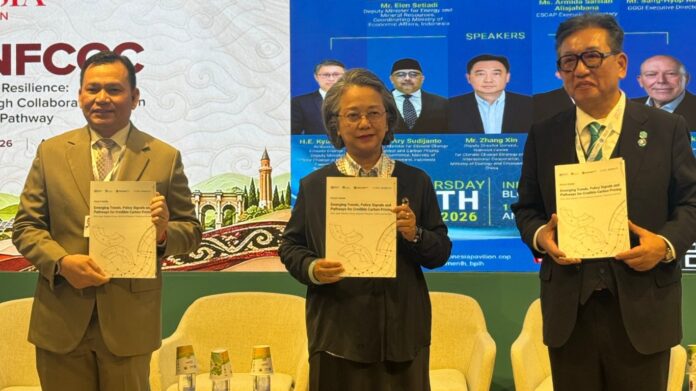
Ecobiz.asia – The Global Green Growth Institute (GGGI) and the United Nations Economic and Social Commission for Asia and the Pacific (UN ESCAP) have outlined policy pathways for strengthening domestic carbon markets in seven Asian countries, with a focus on improving emissions monitoring, expanding market coverage and reinforcing carbon price signals.
The recommendations are contained in a joint policy paper titled Emerging Trends, Policy Signals and Pathways for Credible Carbon Pricing: China, Japan, Republic of Korea, Indonesia, Philippines, Thailand, and Viet Nam, presented during a COP31 dialogue session at the Indonesia Pavilion in Antalya, Türkiye, on Thursday (Nov. 12, 2026).
The paper assesses the readiness of emissions trading systems (ETS) in China, Japan, South Korea, Indonesia, the Philippines, Thailand and Viet Nam, and identifies areas where their carbon pricing frameworks could be improved.
It highlights three priorities for developing credible domestic carbon markets: harmonising measurement, reporting and verification (MRV) frameworks, expanding sectoral coverage, and strengthening carbon price signals. The measures are also intended to lay the groundwork for potential regional carbon market cooperation.
Deputy for Energy and Mineral Resources Coordination at Indonesia’s Coordinating Ministry for Economic Affairs, Ellen Setiadi said regional cooperation between East and Southeast Asian countries would be important for advancing carbon market development through regulatory coordination, technical assistance, capacity building and knowledge exchange.
“Ultimately, carbon markets can support climate-related agendas by mobilising transition finance and creating incentives for emissions reductions,” he said.
UN ESCAP Executive Secretary Armida Salsiah Alisjahbana said carbon pricing could help countries translate their climate commitments into practical economic incentives.
“By putting a price on greenhouse gas emissions, countries encourage cleaner energy solutions, influence business and investment decisions, and generate public revenue that can be reinvested in climate action and the just transition,” she said.
GGGI Executive Director Sang-Hyup Kim said Asian countries were at different stages of carbon market development but shared an interest in establishing credible carbon pricing systems.
“By aligning on the foundations of credible carbon pricing, countries in East and Southeast Asia can move toward linkages that expand opportunities for all,” he said.
The policy paper is an output of the East Asia Carbon Market Collaboration for Developing Asia project, launched in September 2025. It draws on consultations held in August and September 2026 with government agencies, regulators, policymakers, businesses, academics, think tanks and development professionals.
GGGI, UN ESCAP and local partners conducted consultations in six of the seven countries covered by the study: China, Japan, South Korea, Indonesia, the Philippines and Thailand.
The findings will feed into the 2027 Carbon Finance Diagnostic Report and help guide the initiative’s future work. GGGI and its partners plan to use the research to support member countries in developing carbon market policies and mobilising sustainable finance. ***