
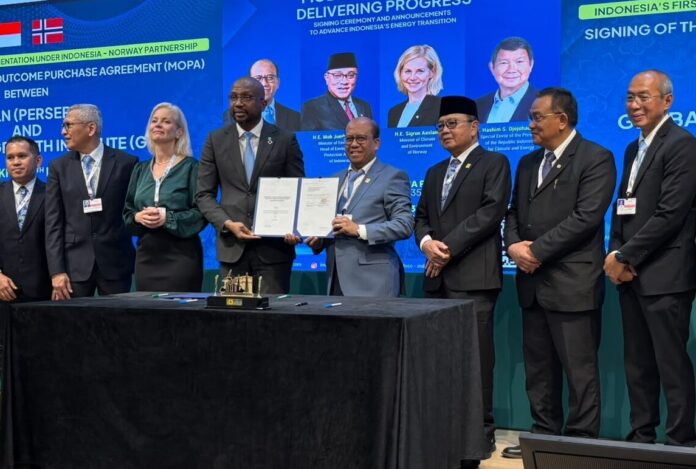
Ecobiz.asia – Indonesia and Norway have signed an agreement to channel international carbon finance into Indonesia’s energy transition, with an initial focus on supporting new renewable energy projects, including floating solar power plants.
The Mitigation Outcome Purchase Agreement (MOPA), signed during the 31st United Nations Climate Change Conference (COP31) in Antalya on Wednesday (Nov. 11), is Indonesia’s first agreement of its kind to implement Article 6.2 of the Paris Agreement.
Facilitated by the Global Green Growth Institute (GGGI), the agreement is expected to be among the largest transactions under Article 6.2 to date. It is supported by the Norwegian Article 6 Climate Action (NACA) Fund, hosted under GGGI’s Carbon Transaction Facility (CTF).
The signing took place at the Indonesia Pavilion and was witnessed by Indonesian Environment Minister and Head of the Environmental Protection Agency Moh Jumhur Hidayat and Norwegian Climate and Environment Minister Sigrun Aasland.
Jumhur said the agreement would help mobilize carbon finance for Indonesia’s energy transition while supporting the achievement of its national climate targets.
“Through this cooperation, we seek to mobilize carbon finance to support Indonesia’s energy transition and contribute to the achievement of our national climate targets,” he said.
He added that the cooperation would also support the development of Indonesia’s Carbon Unit Registry System (SRUK) to ensure transparent recording and tracking of international carbon transfers.
“Our priority is to ensure that this cooperation delivers credible mitigation outcomes, upholds environmental integrity, and is implemented in line with Indonesia’s national climate commitments,” Jumhur said.
Norwegian Climate and Environment Minister Sigrun Aasland said the agreement would enable Norway to finance projects in Indonesia that reduce carbon emissions, including floating solar power development.
“Indonesia has strong ambitions to develop renewable energy and has set bold targets. With this agreement, I hope we can contribute more to the energy transition through solar power and also to emissions reductions,” Aasland said.
The agreement supports Indonesia’s Generation-Based Incentive (GBI) programme, a results-based carbon crediting mechanism designed to accelerate investment in new and additional grid-connected renewable electricity generation.
The programme initially focuses on floating solar photovoltaic (PV) projects, in line with Indonesia’s energy priorities and the objectives of Article 6 of the Paris Agreement. It can also be applied to other renewable energy technologies.
The GBI programme is designed to address financial, regulatory, and grid-related barriers that have slowed renewable energy investment in Indonesia. It provides additional incentive payments when the standard electricity purchase price is insufficient to make eligible projects financially viable.
Projects combining renewable energy generation with battery energy storage systems (BESS) are also prioritized. The combination is intended to enable renewable electricity to be supplied during peak demand and evening hours, when grid emissions are highest, while improving grid stability and reducing intermittency.
Participation in the programme is voluntary. Independent power producers (IPPs) can apply if they meet established financial, technical, and geographical criteria and demonstrate additionality, measurable emissions reductions, and positive sustainable development impacts.
The programme will use a digital monitoring, reporting, and verification (MRV) system to track electricity generated and supplied to the grid. The data will undergo independent audits to ensure accuracy and transparency. Carbon payments will then be made to project operators based on verified performance.
The resulting emissions reductions will be aggregated, authorized, and transferred as Internationally Transferred Mitigation Outcomes (ITMOs) under the bilateral cooperation between Indonesia and Norway, as part of the Norwegian Global Emissions Reduction (NOGER) Initiative.
The programme will apply dynamic baselines anchored in Indonesia’s unconditional Nationally Determined Contribution (NDC) to maintain environmental integrity and ensure alignment with national climate targets.
Following the signing, GGGI will work with the Indonesian government, state-owned electricity company PT PLN (Persero), and Norway’s Ministry of Climate and Environment to finalize the implementation and operational arrangements.
GGGI Executive Director Sang-hyup Kim said the agreement demonstrated the transition of Article 6 from preparatory work towards actual implementation.
“Article 6 is moving from readiness to implementation, and this agreement is a clear example of what that transition requires: strong national drive and dedicated partners,” Kim said.
He added that results-based mechanisms could provide governments and investors with greater certainty to mobilize financing for climate action at scale. ***