
Ecobiz.asia – The United Nations Environment Programme (UNEP) has praised Indonesia’s jurisdictional REDD+ programme across nine provinces, describing its large-scale approach as an important model for other forest countries in linking national climate ambitions, provincial implementation, and international carbon market standards.
Martin Krause, Director of UNEP’s Climate Change Division, said Indonesia was not waiting for the global carbon market to define integrity standards but was helping shape them through a programme covering 38.6 million hectares of forest, equivalent to nearly half of Türkiye’s territory.
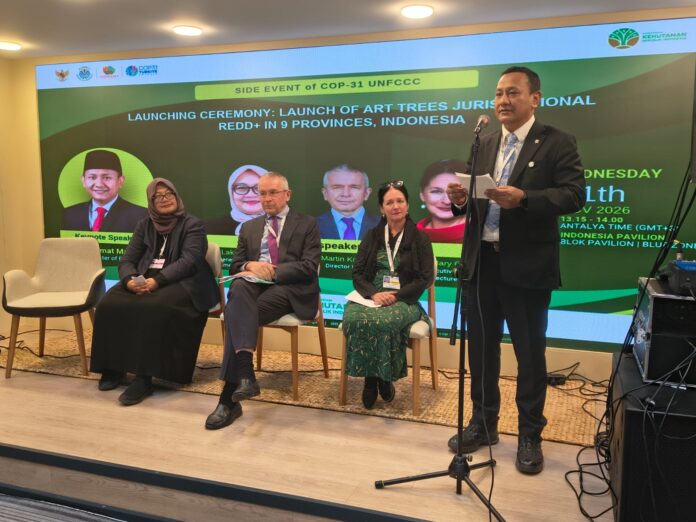
“Indonesia is not waiting for the global carbon market to define what integrity is. Indonesia is helping to define it and is helping to define it at scale,” Krause said at the launch of Indonesia’s ART TREES Jurisdictional REDD+ Programme at the Indonesia Pavilion during COP31 in Antalya, Türkiye, on Wednesday (Nov. 11, 2026).
He said very few countries had attempted to develop such an approach at this scale, making Indonesia’s initiative an important model for other forest countries.
UNEP has witnessed the implementation of jurisdictional REDD+ efforts firsthand in Riau through the UN-REDD programme, supported by funding from the United Kingdom alongside broader national efforts supported by Norway.
Krause said Riau demonstrated what high-integrity forest carbon programmes require in practice, including safeguards, benefit-sharing arrangements, inclusive consultations that give communities a meaningful voice, and innovative approaches to peatland rewetting and ART TREES methodologies.
“This experience is now a practical reference for the other eight provinces,” he said.
He emphasized that the benefits of protecting and restoring forests, particularly peatlands, extend beyond carbon emissions reductions. Such efforts can reduce the risks of fires and haze, protect water systems, and support local livelihoods.
Citing UNEP’s recent global co-benefit assessment, Krause said high-risk tropical forests help avoid approximately US$81 billion in disaster-related losses annually.
“These are economic returns that a carbon price alone does not capture. These co-benefits strengthen the case for jurisdictional REDD+,” he said.
However, Krause stressed that high-quality carbon credits alone would not be sufficient to mobilize the financing needed to support forest protection and restoration. The carbon market must also respond with stronger demand from buyers and investors.
He identified three key requirements for mobilizing finance: clarity, credibility at scale, and equity.
Clarity requires transparent accounting, clear ownership and authorization, and mechanisms to prevent double counting. Credibility at scale requires robust baselines, independent verification, and effective management of leakage and reversal risks. Equity, meanwhile, requires fair participation and benefit-sharing arrangements.
“These requirements take significant investment, often years before credits can be issued,” Krause said.
He added that jurisdictions therefore need early engagement with buyers, readiness financing, and predictable longer-term purchase commitments to support programme implementation before carbon credits are issued.
Krause said Indonesia’s approach offered opportunities to access results-based payments, voluntary carbon markets, and cooperation under Article 6 of the Paris Agreement, while translating its FOLU Net Sink 2030 ambitions into financing and tangible results on the ground.
“Today, this moment here marks the beginning of the next phase. It is not the end of this work. It also marks a real test for high-integrity supply into sustained demand and finance,” he said.
UNEP, he added, would continue supporting Indonesia and its provincial partners through the registration and verification processes, with the eventual goal of carbon credit issuance.
Indonesia launched its ART TREES Jurisdictional REDD+ Programme covering nine provinces and approximately 38.6 million hectares of forest, or around 40% of the country’s total forest cover.
The programme’s TREES Concept has been accepted by the Architecture for REDD+ Transactions (ART) and published on the ART Registry, marking the first step towards registering the jurisdictional REDD+ programmes.
Deputy Minister of Forestry Rohmat Marzuki, Director General of Sustainable Forest Management Laksmi Wijayanti, and ART Executive Director Mary Grady also attended the launch.
Under the programme, Central Sulawesi, East Kalimantan, Jambi, and Riau will pursue credits through reducing emissions from deforestation and forest degradation, while North Maluku, Papua, West Papua, Southwest Papua, and Papua Highlands will participate under the High Forest, Low Deforestation (HFLD) approach.
The next steps include the submission of TREES Registration Documents and TREES Monitoring Reports for each accounting area, followed by independent third-party audits before the ART Board can approve the issuance of carbon credits. Indonesia will use the latest version of the standard, TREES 3.0. ***