
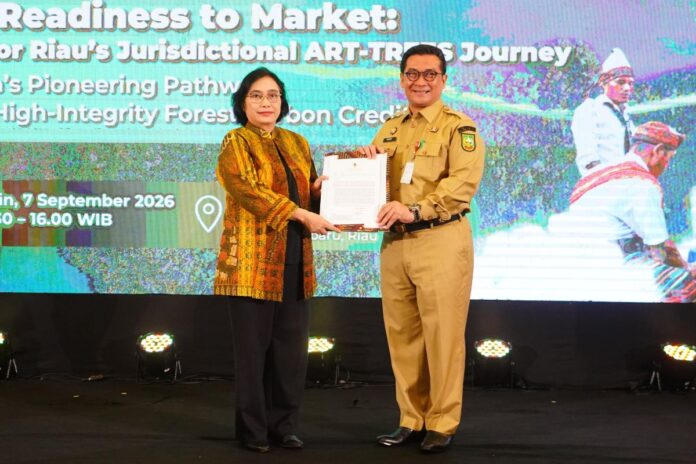
Ecobiz.asia — Indonesia’s Ministry of Forestry has backed Riau province’s plan to develop a jurisdictional forest carbon program under the ART-TREES standard, allowing the province to move forward with registration of its Green for Riau initiative.
Riau Provincial Secretary Syahrial Abdi said the central government’s support provides an important foundation for the province to proceed with the registration process and ensures that the Green for Riau initiative remains aligned with Indonesia’s national climate policies.
“Riau is not starting this journey from zero. We already have the institutions, the direction and the roadmap. Now we are moving toward implementation,” Syahrial said at the High-Level Meeting of the Green for Riau Initiative in Pekanbaru on Monday (Sept. 7, 2026).
Riau has completed the Concept Note for Green for Riau, with the next steps including preparation of a Registration Document and a monitoring system through Monitoring Reports in accordance with the ART-TREES standard.
The jurisdictional performance measurement area covers about 2.6 million hectares, including around 1.77 million hectares of peatland. The area encompasses 818 villages, 138 Indigenous communities and 141 social forestry groups.
The scale of the program reflects Riau’s role in protecting forests, peatlands and biodiversity while supporting communities whose livelihoods depend on natural resources, Syahrial said.
The Green for Riau initiative is not designed solely as a carbon trading program, he said. The initiative—short for Growing Resilience through Emissions Reductions, Community Empowerment and Ecosystem Restoration for a Nurturing Future—is intended to support broader development transformation through emissions reductions, community empowerment and ecosystem restoration.
The province launched Green for Riau as a province-wide forest and peatland conservation program aimed at strengthening sustainable forest management and supporting Indonesia’s climate commitments.
The program is supported by the UN-REDD Programme and funded by the UK government through the UK Foreign, Commonwealth and Development Office (UK FCDO).
Syahrial said financing is a key reason for developing the initiative. Based on provincial planning assessments, Riau faces a financing gap of about Rp4 trillion to support its contribution to the FOLU Net Sink 2030 agenda.
“Climate finance for Riau is not merely an alternative. It is becoming an important part of our development strategy going forward,” he said.
Forestry Ministry stresses integrity
Forestry Ministry Senior Advisor for Climate Change Haruni Krisnawati said the ministry welcomed Riau’s progress in developing jurisdictional REDD+.
She said Riau had established several elements needed for readiness, including program planning, measurement, reporting and verification (MRV) systems, a forest reference emission level (FREL), safeguards, benefit-sharing mechanisms, a nesting approach, carbon accounting and a REDD+ information system.
These elements need to be consolidated into an integrated framework that is consistent with national policies before Riau moves further into the carbon market, Haruni said.
“The market is certainly not the starting point. Before we get there, we need to make sure that the program we implement has a clear policy basis,” she said.
Haruni said emissions reductions generated by the program must be supported by transparent and verifiable data and calculation methods that are consistent with Indonesia’s national systems.
Social safeguards must also be incorporated, including respect for the rights of Indigenous and local communities and meaningful participation, she said.
She also highlighted the need to coordinate REDD+ activities at different scales to ensure consistent accounting and prevent double counting and double claiming, while integrating mitigation actions implemented within Riau’s jurisdiction.
ART-TREES is among the international standards Riau is seeking to use for its jurisdictional program. Haruni said the Ministry of Forestry was ready to facilitate further review of the Green for Riau Concept Note and subsequent steps in accordance with international standards and national regulations.
“Once all applicable requirements have been fulfilled, the ministry will facilitate the next process for registering the Concept Note with ART-TREES, in accordance with national authorities and procedures,” she said.
Haruni stressed that the ministry’s support would not eliminate technical reviews at each stage, which she said were necessary to maintain the credibility and integrity of the program.
The jurisdictional REDD+ program in Riau also needs to be connected to Indonesia’s national accounting and registry systems, including the National Registry System (SRN) and the Carbon Unit Registry System (SRUK), as well as applicable authorization mechanisms, she said.
With these systems in place, Riau could access results-based finance and high-integrity carbon markets, Haruni said.
Riau prepares benefit-sharing mechanism
Syahrial said the provincial government would seek to ensure that economic benefits from carbon projects are distributed fairly among local communities.
Riau plans to develop a participatory benefit-sharing plan covering stakeholder mapping, the principle of Free, Prior and Informed Consent (FPIC), protection of Indigenous and local communities, protection of natural forests and biodiversity, and risk management.
“Success should not be measured only by our ability to generate verified emissions reductions. The credibility of Green for Riau must also be determined by how its benefits are managed, who receives them and what impact they create,” Syahrial said.
To improve transparency, the provincial government has also launched a Green for Riau website and a Feedback and Grievance Redress Mechanism (FGRM), which are intended to provide information, communication, transparency and grievance channels for communities and partners involved in the program.
Syahrial said the next phase would require cooperation among the central and provincial governments, communities, businesses, academics, civil society organizations and development partners to ensure that emissions reductions, ecosystem protection and economic benefits advance together. ***