
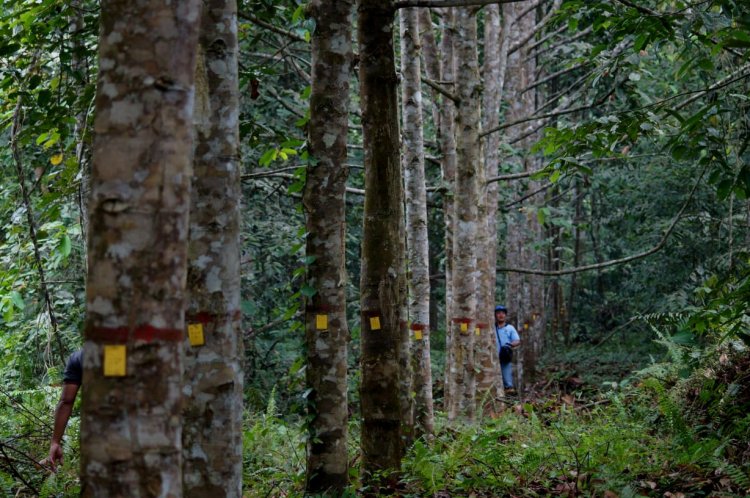
Ecobiz.asia – Indonesia’s Ministry of Forestry has designated around 5.67 million hectares of forest areas for a broader range of uses, including food production, bioenergy, non-timber forest products and environmental services, as the government shifts away from a predominantly timber-based approach to forest utilization.
The allocation is set out in the 2026 Forest Utilization Direction Map (PAPH) for Business Licenses for Forest Utilization (PBPH). The ministry said the map forms part of a broader change in how production and protection forests are utilized.
Laksmi Wijayanti, Director General of Sustainable Forest Management at the Ministry of Forestry, said future forest utilization should not focus solely on timber but also generate economic value while maintaining forest cover.
“We want to prove that standing forests can be more profitable than converted forests. The PAPH is an opportunity to correct how space is utilized in the forestry sector,” Laksmi said at the 2026 PAPH socialization event in Makassar on Thursday (Sept. 24, 2026).
Of the total area covered by the new direction, around 387,641 hectares have been allocated for sugar palm cultivation as a source of bioenergy. Another 68,454 hectares have been designated for agroforestry involving crops such as rice, corn, soybeans, coffee and cocoa.
C. Hendro Widjanarko, Director of Forest Utilization Planning, said sugar palm development would use a mixed-forest approach rather than monoculture plantations because the crop can grow under forest cover.
“Sugar palm actually grows well under shade, with around 50% forest cover. So the model is mixed-use. The forest remains intact while its products can be harvested,” he said.
Forest Services, Carbon and Non-Timber Products
The 2026 PAPH also allocates around 902,298 hectares of compact forest and land rehabilitation areas that are not currently subject to permits.
Within these areas, permit holders may develop environmental services, non-timber forest products and carbon assets while carrying out forest rehabilitation, according to the ministry.
Meanwhile, around 1.33 million hectares of protection forest and 1.37 million hectares of production forest covered by the government’s moratorium area, known as PIPPIB, may only be utilized without altering the landscape.
Activities in these areas are limited to environmental services and non-timber forest products.
The Ministry of Forestry is also tightening the licensing process. All new PBPH applications must now include a recommendation from the relevant provincial governor, while applicants that previously only held proof of submission have up to 90 days to complete the requirement.
Laksmi said involving local governments from the outset was necessary to prevent overlapping claims and utilization of forest areas.
The 2026 PAPH was established through Forestry Ministerial Decree No. 7253/2026 and is publicly accessible through the Ministry of Forestry’s SIGAP portal.
The map is dynamic and will be updated at least once a year. The ministry plans to begin preparing the 2027 PAPH in December 2026, incorporating input from local governments and businesses. ***