
Ecobiz.asia — Singapore and Laos have signed an implementation agreement to establish a legally binding framework for carbon credit collaboration under Article 6 of the Paris Agreement, opening a pathway for the generation and international transfer of high-integrity carbon credits.
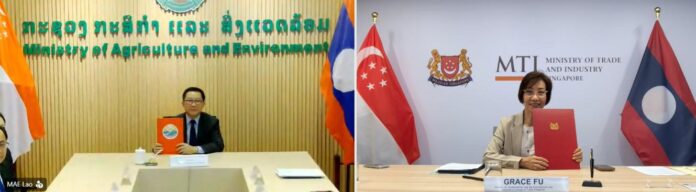
The agreement was signed virtually by Singapore Minister for Sustainability and the Environment and Minister-in-charge of Trade Relations Grace Fu and Lao PDR Minister of Agriculture and Environment Linkham Douangsavanh on Friday (Sept. 4, 2026).
According to Singapore’s Ministry of Trade and Industry (MTI), the deal is Singapore’s 12th implementation agreement on carbon credits and its fourth with an ASEAN member state.
Under the agreement, project developers will be able to develop carbon mitigation projects aligned with the Article 6 rulebook.
The framework covers the international transfer of correspondingly adjusted carbon credits, with details on project authorization and eligible methodologies to be released later.
The carbon credits authorized under the agreement can be used for several purposes in Singapore, including offsetting up to 5% of a company’s taxable emissions under Singapore’s International Carbon Credits framework, subject to eligibility.
The credits can also be used for compliance with national or international mitigation requirements, including the Carbon Offsetting and Reduction Scheme for International Aviation (CORSIA).
Singapore will also channel 5% of proceeds from authorized carbon credits under the agreement to climate adaptation measures in Laos.
In addition, 2% of the correspondingly adjusted carbon credits authorized under the agreement will be cancelled at first issuance. The cancelled credits cannot be sold, traded or counted toward any country’s emissions targets.
Grace Fu said the agreement would create new opportunities in carbon markets for businesses and local communities while strengthening cooperation between the two ASEAN countries.
Linkham said the agreement would provide a transparent and high-integrity framework for developing carbon projects that can create jobs, protect the environment and channel climate finance toward adaptation in Laos.
The corresponding adjustment mechanism is intended to prevent double counting of emissions reductions or removals between the host and buyer countries’ greenhouse gas inventories.
Singapore has previously signed similar implementation agreements with Bhutan, Chile, Ghana, Mongolia, Paraguay, Papua New Guinea, Peru, Rwanda, Thailand, the Philippines and Vietnam. ***