

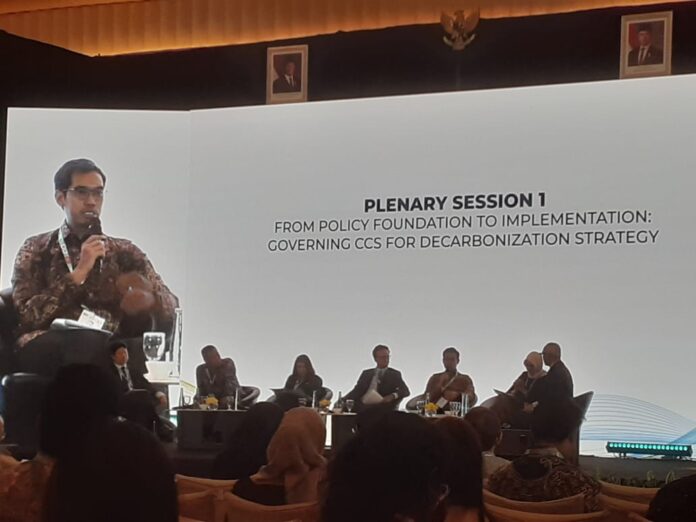
Ecobiz.asia — Indonesia has substantial carbon storage potential and is strategically positioned to become a regional carbon capture and storage (CCS) and carbon capture, utilization and storage (CCUS) hub, according to the Ministry of Energy and Mineral Resources (ESDM).
Dwi Adi Nugroho, Coordinator for the Development of Non-Conventional Oil and Gas Working Areas at the Directorate General of Oil and Gas, Ministry of Energy and Mineral Resources, said studies conducted by the Oil and Gas Research and Development Center (Lemigas) estimated Indonesia’s carbon storage potential at around 500 gigatons (Gt) in saline aquifers and 4 Gt in depleted oil and gas reservoirs.
“This is a substantial storage potential that will have the basis for marketing the emission sources industry to use this potential,” Dwi said during the 4th International & Indonesia CCS Forum 2026 in Jakarta on Wednesday (Aug. 26).
He said Indonesia’s strategic geographic position, combined with its large storage capacity, provides a strong foundation for the country to develop into a regional CCS/CCUS hub, including for cross-border CO2 storage.
The development of a carbon storage hub, he added, could support around 12.5% of Indonesia’s national decarbonization target by 2050, attract nearly $43 billion in investment, contribute cumulatively around 1.6% to Indonesia’s GDP growth, and create more than 80,000 direct jobs through the construction, operation and maintenance of the CCS ecosystem.
Dwi also highlighted the importance of strengthening the regulatory framework to support CCS development. “Clean and clear regulation in terms of the execution aspect will be one of the keys to the successful deployment of CCS,” he said.
He noted that the government has recently issued Government Regulation No. 28/2025 on risk-based business licensing and its implementing regulations. The regulatory framework includes business classifications applicable across the CCS value chain. “The Government of Indonesia is committed to creating a complete regulation for this CCS ecosystem,” Dwi said. Beyond storage services, the government is also seeking to create additional economic value from CCS through the carbon economic value mechanism.
Dwi said Presidential Regulation No. 110/2025 provides the broader framework for carbon economic value, while the Ministry of Energy and Mineral Resources is preparing implementing regulations covering carbon trading and the energy sector.
“We propose to include CCS and CCUS as part of the energy sector activities that can be recognized under the carbon economic value mechanism,” he said. Such recognition, according to Dwi, would allow CCS projects to generate economic value not only from CO2 storage but also from carbon credits.
He further emphasized that the development of CCS cannot be separated from the broader energy transition ecosystem, particularly the development of low-carbon hydrogen and ammonia. “Cross-sector energy synergy is very important. We need a roadmap that has to align to show the readiness of CCS infrastructure, which also affects the development of low-carbon hydrogen and ammonia,” Dwi said.
He said CCS should be viewed as enabling infrastructure that connects the oil and gas industry, renewable energy sector and industrial users. “The ecosystem is essential because we do not work alone. We need all sectors, such as oil and gas, renewables and industry,” he said.
According to Dwi, CCS could serve as a foundation for emerging low-carbon businesses and support Indonesia’s long-term decarbonization strategy. He also stressed the importance of learning from both domestic and international CCS projects before scaling up deployment in Indonesia.
“We have to see the lessons learned from the current or upcoming projects, as well as what has happened in other global projects that are already on stream or in operation,” he said. The lessons, he added, should cover both successful projects and those that encountered difficulties, enabling Indonesia to develop a more reliable CCS ecosystem.
Dwi said international cooperation would also be important, particularly as Indonesia seeks to position itself as a regional CCS hub capable of handling cross-border CO2 storage. “We need to show them that we are ready for that,” he said.***