
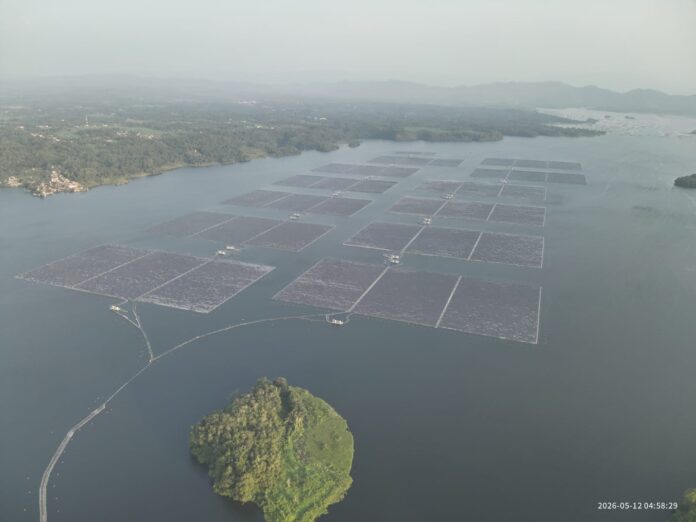
Ecobiz.asia – Indonesia is preparing to scale up renewable energy, but the country is also beginning to confront a less visible consequence of the transition: what happens to solar panels, wind turbines and battery systems once they reach the end of their useful lives.
The issue is still relatively small in Indonesia because the country’s renewable fleet remains at an early stage. But with the government targeting a major expansion of renewable generation, policymakers are increasingly looking at how to build an end-of-life system before large volumes of equipment become waste.
The issue was discussed during Indonesia Sustainable Energy Week (ISEW) 2026 in Jakarta on Wednesday (August 19, 2026), where government officials and industry representatives outlined the policy, regulatory and infrastructure challenges involved in managing renewable-energy equipment at the end of its useful life.
The Ministry of National Development Planning (Bappenas) says Indonesia needs to establish a circular-economy framework for renewable-energy equipment, covering everything from product design and repair to collection, recycling and material recovery.
Nizhar Marizi, Environment Director at Bappenas, said the government needs to begin planning for the end of the equipment lifecycle while renewable projects are still being developed.
The approach includes designing components for longer operating lives, making equipment easier to repair and recycle, establishing product take-back systems and expanding the use of extended producer responsibility, or EPR.
The policy challenge is becoming more urgent as Indonesia’s 2025-2034 electricity supply plan calls for an additional 42.6 GW of renewable generating capacity. The planned expansion includes large additions of solar, wind and energy storage capacity, creating a future waste stream that Indonesia has yet to fully prepare for.
Bappenas also sees the issue as an industrial opportunity. Rather than treating retired renewable-energy equipment simply as waste, the government wants to develop domestic capabilities for repair, refurbishment, recycling and recovery of materials that can be returned to industrial supply chains.
Global trends show why the issue cannot be postponed indefinitely. Bappenas cited projections that retired solar panels could generate more than 3 million tonnes of waste annually by 2035 and as much as 25 million tonnes by 2050. More than 17.7 million tonnes of raw materials could potentially be recovered from the global waste stream.
For Indonesia, the challenge is therefore not only how to dispose of retired equipment, but how to capture the economic value embedded in it.
Building the recycling chain
The Ministry of Energy and Mineral Resources (ESDM) is now mapping what that future recycling chain could look like.
Elis Heviati, Deputy Director for Technical and Environmental Affairs at ESDM’s renewable-energy directorate, said the first requirement is a better understanding of the volume, composition and location of future renewable-energy waste.
ESDM is proposing a database covering waste types, material characteristics, projected volumes and the locations of major waste sources. That information would provide the basis for planning collection facilities, transportation and processing capacity.
The next layer would be logistics. ESDM’s proposed system includes centralized collection points, certified temporary storage for hazardous waste, specialized transport fleets and licensed third-party operators capable of handling equipment from renewable-energy projects across Indonesia.
The downstream infrastructure would be considerably more complex.
ESDM has identified the need for module dismantling facilities, material separation and purification plants, aluminium mini-smelters and facilities capable of recovering materials such as silicon, copper, lithium and silver.
The objective is to eventually create a domestic circular chain in which materials recovered from retired renewable-energy equipment can be returned to the manufacturing sector.
The scale of the challenge varies significantly between technologies.
Solar panels, for example, contain large quantities of glass and aluminium as well as smaller amounts of silicon, copper, silver and other materials. Wind turbines generate steel and other recyclable materials, but their composite blades are significantly more difficult to process.
Battery energy storage systems create another layer of complexity because lithium-ion batteries require specialized handling and can contain valuable as well as hazardous materials.
ESDM’s roadmap therefore goes beyond conventional waste collection. It envisages a new industry involving project developers, waste collectors, certified storage providers, specialized transport companies, dismantlers, processors and recyclers.
Solar waste is coming first
Among the renewable technologies being deployed in Indonesia, solar power is likely to generate one of the country’s first major end-of-life waste streams.
The country’s 2025-2034 electricity plan includes 17.1 GW of new solar capacity. By the second quarter of 2026, however, Indonesia had only around 1.71 GW of installed solar capacity, meaning most of the equipment that will eventually require end-of-life management has yet to be deployed.
Amelia Rachmatunisa, Coordinator of the Cross-Border and Convention Working Group at the Ministry of Environment’s Directorate of Hazardous and Non-Hazardous Waste Management, said Indonesia could generate between around 600,000 tonnes and 1.7 million tonnes of discarded solar panels by 2050, depending on the rate at which modules leave service.
The difference reflects two scenarios presented by the ministry. Under a regular-loss scenario, solar-panel waste could reach around 600,000 tonnes by 2050, while an early-loss scenario could push the figure to as much as 1.7 million tonnes.
The regulatory framework, however, has not yet fully caught up with the coming waste stream.
Amelia said used solar modules do not currently have a specific waste code under Annex IX of Government Regulation No. 22/2021. Their status therefore has to be determined through characteristic testing on a case-by-case basis.
That creates uncertainty for both project developers and companies considering investment in recycling facilities.
The Environment Ministry has identified several measures that could address the gap, including establishing a specific waste classification for solar modules and other plant components, introducing EPR, creating mechanisms to finance recycling, issuing management guidelines for developers and supporting domestic recycling capacity.
The potential material value is significant. A crystalline-silicon solar module is composed of roughly 75% glass and 10% aluminium by weight, with smaller quantities of encapsulant, silicon cells, copper, silver and tin.
The ministry’s presentation cited a potential global recoverable material value of US$15 billion by 2050. Recycling could also reduce supply-chain emissions by as much as 42% compared with producing the same materials from primary resources.
That suggests solar-panel waste could eventually become a source of secondary raw materials rather than simply an environmental liability.
Batteries present a different problem
Battery waste presents a different challenge because its economic value depends heavily on chemistry.
Amelia said Indonesia could generate around 120,000 tonnes of used electric-vehicle batteries by 2030, compared with current domestic recycling capacity of only around 20,000 tonnes per year.
The country already has around 83,000 tonnes of lithium batteries installed across 468,231 electric vehicles.
Unlike solar panels, where the main challenge is establishing a collection and material-separation system, the Environment Ministry sees collection as the weakest link in the battery recycling chain.
Domestic processing capacity from black mass through to battery cells is already available, according to the ministry. The challenge is ensuring that used batteries actually reach those facilities.
Black mass accounts for roughly 35% of a battery pack’s weight and contains valuable materials including lithium, nickel, cobalt, manganese and graphite. Recovery rates can exceed 95% for nickel, cobalt and copper, while manganese recovery can exceed 90%. Lithium recovery ranges from around 50% to 90%, depending on battery chemistry and processing technology.
But not all batteries offer the same economic incentive.
Nickel-manganese-cobalt and nickel-cobalt-aluminium batteries contain relatively high-value nickel and cobalt. Lithium-iron-phosphate, or LFP, batteries contain neither metal and can therefore be significantly less attractive to recycle commercially.
The increasing use of LFP batteries, particularly in electric motorcycles and entry-level vehicles, could create a policy challenge if recycling economics are not supported by incentives or producer-responsibility requirements.
Without such mechanisms, lower-value batteries could accumulate or enter improper disposal channels because recyclers have less economic incentive to process them.
The ministry therefore sees stronger collection systems and producer responsibility as essential if Indonesia wants to turn used batteries into a domestic source of critical minerals.
The concept effectively turns waste management into “urban mining”, recovering nickel, cobalt, lithium, copper, aluminium and graphite from products already circulating in the economy rather than relying entirely on new extraction.
Wind turbines offer a longer window, but tougher materials
Wind energy gives Indonesia more time to prepare, but the waste stream could be technically more difficult to handle.
Indonesia’s existing wind fleet remains relatively small. The Environment Ministry estimates around 147 MW of installed wind capacity represented by 50 turbines, including 30 units at Sidrap and 20 at Tolo.
With typical turbine operating lives of around 20 to 25 years, the first significant wave of decommissioning is expected between 2038 and 2044.
Amelia said Indonesia therefore has roughly 12 years to establish the rules, technology and commercial pathways needed to handle the first major wave of wind-turbine waste.
The biggest challenge will be turbine blades.
The ministry estimates that blade waste from the existing fleet could amount to around 1,500 to 2,200 tonnes. The blades are largely made from glass-fibre or carbon-fibre reinforced thermoset composites, which cannot simply be melted and remanufactured like conventional metals.
One option identified by the ministry is co-processing in the cement industry, although the presentation did not indicate that such a route has already been commercially established or approved.
Other turbine components offer more conventional recycling opportunities. Steel towers and foundations can enter scrap-metal and aggregate markets, while nacelles and generators contain copper, steel and neodymium-iron-boron magnets that could potentially support metal and rare-earth recovery.
Lubricants and gearbox oils, meanwhile, are classified as hazardous waste and require licensed handling.
The relatively small volume of wind waste today gives Indonesia an opportunity to develop a solution before the waste stream becomes significant. The risk is that the country waits until turbines are already reaching retirement before establishing standards and processing capacity.
From waste problem to industrial opportunity
The emerging picture suggests Indonesia’s renewable-energy transition will eventually create a second industrial ecosystem alongside power generation itself.
PT Citra Asia Raya, an Indonesian hazardous-waste processor, is already demonstrating one possible model for solar-panel recycling.
Dony Sulistyo of PT Citra Asia Raya presented a process in which retired solar panels are dismantled, heated and crushed before their material streams are separated.
The process begins by removing the panel frame and heating the module to soften the adhesive that holds the layers together. The glass, solar cells and backsheet are then separated and processed further.
Glass can be converted into glass powder, while the backsheet produces a plastic fraction. The solar-cell portion produces silicon and metal-bearing powder containing copper, aluminium and silver.
The metal-bearing fraction can then be processed through a smelter to produce alloy ingots, while the glass and plastic fractions are transferred to licensed third parties for further processing.
The example illustrates the potential complexity of the future recycling business. A retired solar panel does not simply move from a collection point to a recycling plant. It can require dismantling, thermal treatment, crushing, separation, purification and metallurgical processing before its materials can re-enter industrial supply chains.
Citra Asia Raya’s presentation did not disclose its current solar-panel recycling capacity, investment value or commercial processing volume.
Nevertheless, the process points to where the industry could develop as Indonesia’s renewable fleet grows.
The policy needs to come before the waste
For Indonesia, the central question is no longer whether renewable-energy equipment will eventually become waste. It is whether the country will have built the institutions, infrastructure and business models to deal with it when that happens.
Bappenas’ broader circular-economy agenda provides the policy framework, while ESDM is mapping the physical infrastructure required to collect and process the materials. The Environment Ministry, meanwhile, is addressing the classification, hazardous-waste and producer-responsibility issues that determine how those materials can legally move through the economy.
The opportunity is significant. Indonesia’s National Circular Economy Roadmap and Action Plan has been incorporated into development planning, with priorities including resource efficiency, higher recycling rates, greener products and a stronger recycling ecosystem.
The wider circular economy could potentially add Rp593 trillion to Rp638 trillion to Indonesia’s GDP by 2030 and create around 4.4 million green jobs, according to estimates cited by Bappenas. Those figures cover the broader circular economy and are not specific to renewable-energy equipment recycling.
Still, renewable-energy waste could become one component of that larger industrial transformation.
The challenge is timing. Solar panels may have operating lives of 25 to 30 years, while the first major wind-turbine waste is still more than a decade away. Batteries, however, are likely to become a much more immediate issue as electric vehicles and energy storage expand.
That gives Indonesia a window to establish the rules before waste volumes become overwhelming.
If collection, producer responsibility, recycling standards and material-recovery infrastructure are developed alongside renewable deployment, retired equipment could become a source of secondary raw materials, new services and industrial jobs.
If they are developed only after the waste arrives, the energy transition could leave Indonesia with a new waste problem that it had the opportunity to anticipate. *** Editing by Sugiharto Budiman