

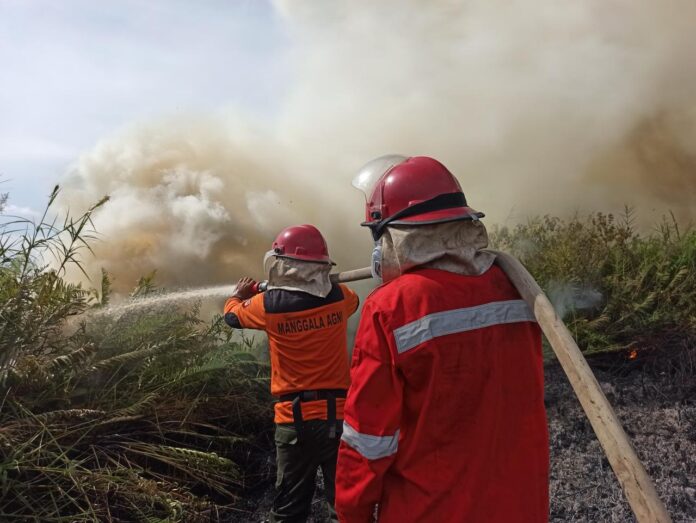
Ecobiz.asia — Indonesia’s Ministry of Forestry will calculate greenhouse gas emissions from forest and land fires in 2026 as part of an assessment of progress toward the country’s Forest and Other Land Use (FOLU) Net Sink 2030 target.
Forestry Minister Raja Juli Antoni said the calculation would use the area affected by fires and compare this year’s figures with conditions in 2015, when Indonesia experienced a severe El Niño event.
“We will keep forest and land fires below the 2015 level, including their potential carbon emissions. Whatever the final figure is, I believe we will calculate it more accurately and report it transparently to the media,” Raja Juli said in Jakarta on Tuesday (Sept. 1, 2026).
The ministry recorded 202,004.3 hectares of forest and land fires nationwide between January and July 2026.
About 57%, or 115,896.5 hectares, occurred inside forest areas, while the remaining 43%, or 86,107.8 hectares, occurred outside forest areas, classified as other land-use areas (APL).
The 2026 figure remains below the approximately 600,000 hectares recorded during the same period in 2015.
Raja Juli said the area affected by fires would be among the key inputs in calculating the resulting carbon emissions this year.
The government is using 2015 as a benchmark because the intensity of the 2026 El Niño event is considered comparable to that of 2015.
“I cannot say that with certainty yet, but internally we have set 2015 as the benchmark. If El Niño was that severe and the level was that high, we will keep forest and land fires below the 2015 level, including their potential carbon emissions,” he said.
Ministry data for August 2026 showed that high-confidence hotspots remained concentrated in several priority provinces.
West Kalimantan recorded the highest number, with 6,910 hotspots, followed by Central Kalimantan with 4,815, South Sumatra with 1,489, South Kalimantan with 809, Riau with 243 and Jambi with 213.
In Central Kalimantan, the highest daily number was recorded on Aug. 29, at 1,116 hotspots. West Kalimantan also recorded its August peak on Aug. 29, with 899 hotspots. ***