

Ecobiz.asia – Indonesia is positioning transport decarbonization as a key pillar of its energy security strategy while rolling out a nine-point roadmap to eliminate overloaded and oversized freight vehicles under its Zero Over Dimension Over Load (Zero ODOL) policy.
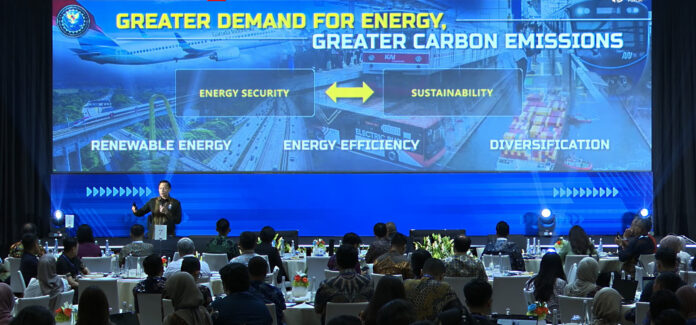
Speaking at the Indonesia Zero Emission Heavy Duty Vehicle (IZEHDV) Forum in Jakarta on Thursday (July 23, 2026), Coordinating Minister for Infrastructure and Regional Development Agus Harimurti Yudhoyono said reducing transport emissions is not solely an environmental agenda but also essential to strengthening national energy resilience, lowering logistics costs and protecting the economy from global energy market volatility.
“Amid growing global uncertainty, Indonesia must strengthen its energy independence. Energy security is fundamental to sustaining economic growth, supporting industrial development, and ensuring affordable and reliable energy supplies for more than 280 million Indonesians,” Yudhoyono said.
He noted that geopolitical tensions have disrupted global energy supply chains, pushing up oil prices and increasing pressure on domestic inflation, underscoring the need to reduce Indonesia’s dependence on imported fossil fuels.
According to Yudhoyono, the energy sector accounts for around 55% of Indonesia’s carbon emissions, with transportation contributing approximately 22% of that total. Road transport generates nearly 89% of transport-sector emissions, while heavy-duty vehicles—despite numbering only about three million units—account for roughly 31% of road transport emissions.
To address the challenge, the government is promoting vehicle electrification, expanding the use of B50 biodiesel, and encouraging the development of domestic electric truck and bus manufacturing.
“Vehicle electrification requires supportive policies, public awareness, and the right incentives. At the same time, we want Indonesia’s electric vehicle industry to continue growing and create broader economic benefits,” he said.
Yudhoyono added that increasing the share of domestically produced renewable energy and biofuels would reduce Indonesia’s exposure to fluctuations in global oil markets.
Alongside decarbonization efforts, the government has introduced a nine-point action plan to implement its Zero ODOL policy, targeting overloaded and oversized trucks that have long contributed to road damage, traffic accidents and inefficient freight transport.
The roadmap includes integrating electronic licensing and vehicle databases, strengthening freight vehicle monitoring and enforcement, revising road classification and vehicle weight regulations, expanding multimodal logistics infrastructure, introducing incentive and disincentive mechanisms, assessing the policy’s impact on logistics costs and inflation, improving workforce capacity, harmonizing regulations, and establishing a cross-agency coordination committee.
Government estimates suggest the policy could contribute up to 0.05% of Indonesia’s gross domestic product, generate potential investment of Rp42.4 trillion (approximately US$2.36 billion), and create social benefits valued at around Rp1.4 trillion.
Yudhoyono said overloaded trucks not only increase accident risks but also impose significant costs on public infrastructure.
“Every year the government spends more than Rp40 trillion maintaining roads damaged by overloaded and oversized vehicles,” he said.
He emphasized that implementing the Zero ODOL policy would improve road safety, reduce logistics costs, lower carbon emissions, and create a more efficient and competitive national freight system.
The government also plans to strengthen alternative freight transport by expanding rail-based logistics and maritime shipping capacity to reduce reliance on road transport.
“When we reduce overloaded trucks, we are not only cutting carbon emissions. We are also reducing traffic accidents, lowering road maintenance costs, and building a more efficient logistics system that ultimately benefits businesses and consumers through lower distribution costs and more stable prices,” Yudhoyono said. ***