
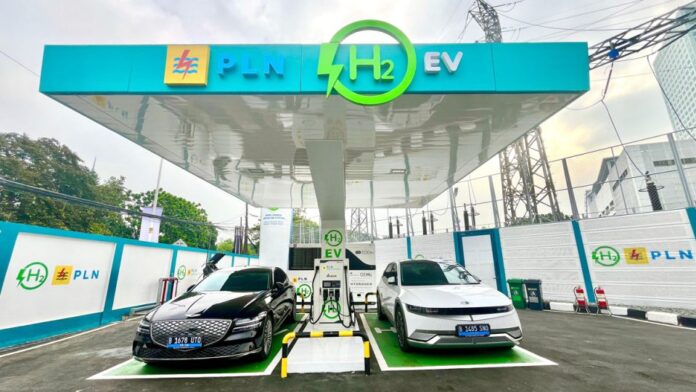
Ecobiz.asia – Indonesia’s state-owned electricity company PT PLN (Persero) has an annual surplus of around 125 tons of hydrogen that could be supplied to support the country’s emerging hydrogen-powered transport sector, according to PLN President Director Darmawan Prasodjo.
Speaking at the Global Hydrogen Ecosystem Summit (GHES) 2026 in Jakarta on Tuesday (July 21, 2026), Darmawan said PLN currently produces about 203 tons of hydrogen each year, primarily for generator cooling systems at its power plants. However, only about 75 tons are consumed internally, leaving approximately 125–130 tons available for external use.
“Every PLN power plant produces hydrogen because it is used in generator cooling systems. We produce around 203 tons annually, but only 75 tons are utilized. The remaining 125 to 130 tons is surplus and can be used for other purposes,” Darmawan said.
He said the excess production has become the basis for collaboration between PLN and state-owned energy company Pertamina to develop Indonesia’s domestic hydrogen supply chain.
According to Darmawan, Indonesia’s first Hydrogen Refueling Station (HRS) in Jakarta has already been established using PLN’s surplus hydrogen, meaning the fuel supply and refueling infrastructure are already in place.
“The hydrogen refueling station is ready. The hydrogen is available. What we need now are the vehicles,” he said.
PLN has held discussions with several automotive manufacturers, including Toyota, as well as companies from Germany and China, regarding the deployment of hydrogen-powered buses.
Darmawan said he hopes Indonesia’s Ministry of Energy and Mineral Resources will facilitate broader cooperation, including with Jakarta’s TransJakarta bus operator, to accelerate the introduction of hydrogen buses.
“PLN and Pertamina are ready to provide the hydrogen supply and refueling infrastructure. The next step is to introduce hydrogen buses so that we can jointly build a hydrogen-based transportation ecosystem,” he said.
Beyond transportation, Darmawan said PLN also plans to integrate hydrogen into its diesel replacement (dedieselization) program for isolated power systems.
He explained that excess electricity generated from renewable energy can be converted into hydrogen through electrolysis and stored for later use, enabling hydrogen to function as a long-duration energy storage solution that supports a more flexible and reliable electricity system.
“As we continue expanding renewable energy, hydrogen will become one of the key energy storage solutions for Indonesia’s future power system,” Darmawan said. ***