
Ecobiz.asia – Indonesia has issued new rules governing carbon trading through greenhouse gas (GHG) emissions offset projects in the agricultural sector, covering rice cultivation, livestock and plantations, with mandatory benefit-sharing arrangements between project developers and farmer institutions.
The rules are set out in Agriculture Minister Regulation No. 18/2026 on Procedures for Carbon Trading Through Agricultural Sector Greenhouse Gas Emissions Offsets.
Agriculture Minister Andi Amran Sulaiman signed the regulation on Oct. 6, 2026, to implement Presidential Regulation No. 110/2025 on the Implementation of Carbon Economic Value Instruments and National Greenhouse Gas Emissions Control.
Under the regulation, carbon offset activities can be undertaken by businesses, government entities and farmer institutions. Eligible mitigation measures include reducing emissions from agricultural activities and increasing carbon absorption and storage on agricultural land.
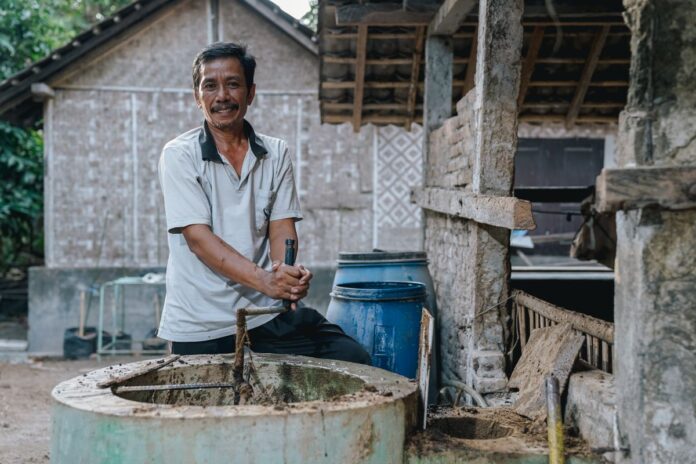
Emission-reduction measures include low-emission farming technologies and practices, such as water management in rice fields, low-emission crop varieties, balanced fertilizer application, crop residue management, soil amendments and livestock waste management.
Carbon sequestration and storage activities may include increasing soil carbon, planting perennial crops and cover crops, rehabilitating degraded agricultural land, and adopting conservation agriculture practices.
Carbon Projects
The regulation requires businesses developing agricultural carbon offset projects to establish benefit-sharing partnerships with at least three farmer institutions located around project sites. The arrangement must take into account the area of land and/or the size of business units involved.
Partnerships must be formalized through agreements specifying each party’s obligations, a proportional distribution of benefits and the duration of the agreement. The arrangements must be based on free, prior and informed consent.
Benefit-sharing proportions are to consider the cost of technologies used, land area or business-unit size, the amount of GHG emissions reduced, and the number of carbon units generated.
Farmer institutions may also develop carbon trading projects independently, including through cooperatives or other legally recognized business entities. Alternatively, they can work with partners or facilitators acting on their behalf and financing project activities under agreed terms.
Registration, Validation and Verification
To obtain a recommendation for an Agricultural Greenhouse Gas Emissions Reduction Certificate, known by its Indonesian abbreviation SPE GRK, project developers must register a Climate Change Mitigation Action Design Document through the Carbon Unit Registry System (SRUK).
The document must include the proposed mitigation measures, methodologies and standards, environmental and sustainable development impact assessments, public consultations, land legality, baseline emissions data, and social and environmental safeguards.
The Ministry of Agriculture will assess project proposals with support from a technical team. The document assessment must be completed within 30 days of submission through the SRUK.
Once the design document has been formally recognized in the registry, project developers must appoint an independent validation body with competent agricultural-sector validators. The body must be accredited by Indonesia’s National Accreditation Committee and registered in the SRUK.
After mitigation activities have been implemented, the resulting emissions reductions must be verified by a qualified independent verification body. The verification results will form the basis for applying to the agriculture minister for a recommendation for an SPE GRK through the registry.
The regulation also provides an approval pathway for carbon units other than SPE GRK, with validation and verification requirements referring to internationally accredited bodies.
To protect project integrity, assessments will cover compliance with methodologies, data completeness, community rights, gender equality, ecosystem and biodiversity conservation, and the management of reversal and emissions-displacement risks.
Applications for recommendations may be rejected if the same emissions reductions are used or claimed by more than one party, scheme or mitigation target.
Cross-Sector Carbon Projects
The regulation also covers carbon trading projects spanning multiple sectors, including agroforestry, biochar use and biogas management.
Such activities must be coordinated with the steering committee responsible for carbon economic value instruments and national GHG emissions control, alongside the relevant ministries or agencies overseeing the sectors involved.
Carbon project participants are required to report on trading activities, community participation, implementation of benefit-sharing agreements and follow-up actions on public complaints to the agriculture minister.
The government will conduct evaluations at least once a year, covering methodologies, carbon potential, document completeness, community involvement and benefit-sharing arrangements. ***