

Ecobiz.asia — Indonesia has assured international donors and investors that its new innovative financing scheme for national parks and iconic species conservation will prioritize ecological protection and local community welfare over commercial interests, as the government seeks to mobilize long-term funding for biodiversity conservation.
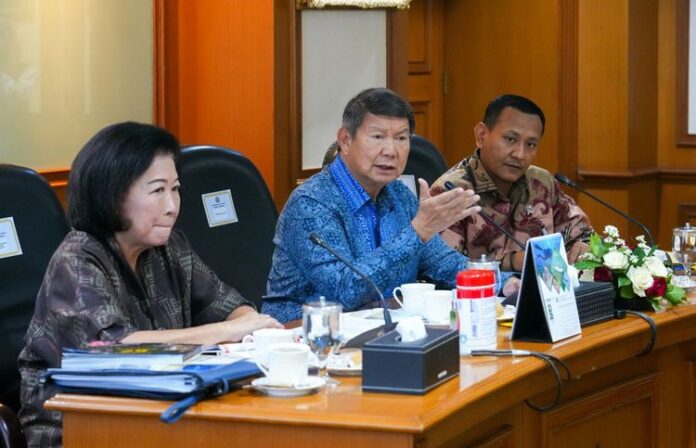
The commitment was emphasized during the Donors and Investors Consultation Meeting on Innovative Financing for National Park Management and Iconic Species Conservation held in Jakarta on Monday (June 8, 2026).
Chair of the Task Force on Innovative Financing for National Parks and Iconic Species Conservation, Hashim Djojohadikusumo, said the initiative reflects President Prabowo Subianto’s high-level political commitment to reforming Indonesia’s conservation financing system to make it more reliable, effective, and sustainable.
“Recognizing the importance of global collaboration, the Government of Indonesia invites international stakeholders to build tactical synergies in safeguarding these global natural assets through the Innovative Financing Task Force for National Parks,” Hashim said.
He explained that the task force is implementing a “two-track strategy” to strengthen conservation financing. The first track focuses on creating a supportive investment climate through regulatory reform, institutional strengthening, and policy development. The second track centers on attracting direct investment by preparing investable project pipelines and designing green financial instruments together with international partners.
According to Hashim, the two approaches are designed to reinforce each other, with pilot projects expected to become the foundation for broader conservation system reforms.
Forestry Minister Raja Juli Antoni, represented at the meeting by Deputy Forestry Minister Rohmat Marzuki, said Indonesia is moving beyond policy discussions toward concrete implementation of innovative conservation financing mechanisms.
He said the government is preparing regulatory reforms and short-term “quick win” programs to reduce dependence on state budgets and strengthen financial sustainability for national parks and species protection efforts through modern green economic instruments.
As part of the initial implementation phase, the Ministry of Forestry is accelerating the transformation of four pilot national parks, Komodo National Park, Bromo Tengger Semeru National Park, Rinjani National Park, and Way Kambas National Park, into Public Service Agency (BLU) entities.
Deputy Chair of the task force for Conservation Investment, Mari Elka Pangestu, said the BLU mechanism is intended to ensure that economic benefits generated from conservation areas are reinvested into ecosystem protection and local community development.
“The core principles underpinning this financing ecosystem are participation, equitable access, and community benefit sharing,” Mari Elka said.
She stressed that all green financing instruments developed under the initiative would be subject to strict monitoring, evaluation, and governance standards to maintain environmental integrity and accountability.
Mari Elka added that Indonesia is seeking not only financial support from international partners but also technical expertise, institutional knowledge, and global best practices to strengthen governance frameworks and monitoring systems.
“Input from development partners is essential in designing regulatory instruments, strengthening institutional capacity, building accountable governance systems, and establishing rigorous monitoring standards,” she said.
The Indonesian government’s emphasis on transparency and environmental integrity received positive responses from diplomats and international organizations attending the consultation meeting, with several development partners expressing readiness to support the initiative and collaborate on biodiversity conservation efforts in Indonesia. ***