

Ecobiz.asia — Indonesia’s Ministry of Marine Affairs and Fisheries is preparing a greenhouse gas emissions baseline for seagrass ecosystems as part of efforts to strengthen national blue carbon governance and enhance the marine sector’s contribution to climate change mitigation.
The baseline was discussed during a technical workshop on seagrass greenhouse gas baseline development and marine sector emissions data governance held in Jakarta recently, involving government agencies, academics and related stakeholders.
Director General of Marine Management at the ministry Koswara said establishing the seagrass emissions baseline would provide a key foundation for strengthening Indonesia’s blue carbon management framework.
“The data will serve as a scientific basis to measure the contribution of coastal ecosystems in absorbing or releasing greenhouse gas emissions while supporting the formulation of climate mitigation policies in the marine and fisheries sector,” Koswara said in a statement on Thursday (March 12, 2026).
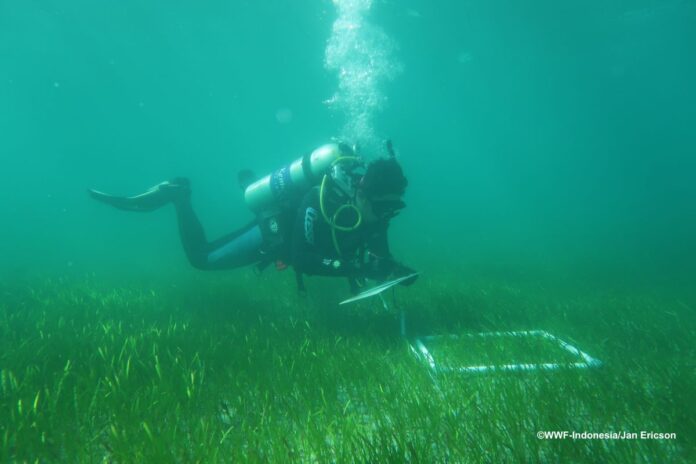
Seagrass ecosystems are a key component of coastal environments with a strong capacity to absorb and store large amounts of carbon. Alongside mangroves and coral reefs, they form part of nature-based solutions known as blue carbon that can support climate change mitigation.
The emissions baseline will help determine the initial condition of carbon stocks as well as the potential emissions resulting from changes or disturbances to seagrass ecosystems. The information will serve as a basis for developing emission reduction scenarios and strengthening sustainable coastal ecosystem management policies.
The workshop also highlighted the importance of strengthening an integrated marine sector emissions data system to support transparent monitoring, reporting and evaluation of the sector’s climate contributions.
Director of Ecosystem Conservation at the ministry Firdaus Agung said strengthening methodologies and emissions data governance would be a key element in supporting sustainable ocean development.
“The methodology for establishing the seagrass emissions baseline is expected to strengthen the marine and fisheries sector’s emissions data system so it becomes more integrated and credible,” he said.
Meanwhile, climate change expert Rizaldi Boer of IPB University said a scientific approach in determining the seagrass emissions baseline is crucial to ensure that the marine sector’s contribution to climate mitigation can be measured accurately. ***