

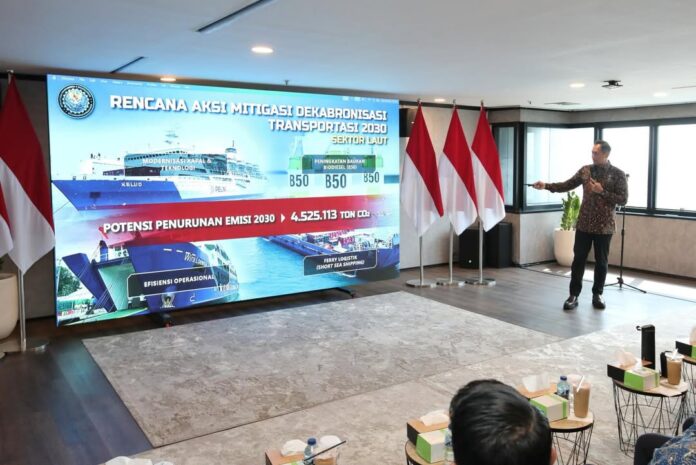
Ecobiz.asia — Indonesia is preparing a national roadmap to decarbonise its transport sector as part of efforts to cut carbon emissions and meet its net zero target by 2060.
Coordinating Minister for Infrastructure and Regional Development Agus Harimurti Yudhoyono said the transport decarbonisation roadmap is expected to be finalised and released in May 2026 following coordination among ministries, state agencies and state-owned enterprises.
“We have a clear timeline. By May, we expect to have a final product for Indonesia’s transport decarbonisation roadmap,” Yudhoyono said at a town hall meeting on accelerating transport decarbonisation in Jakarta on Monday (Jan. 26, 2026).
Indonesia, which ratified the Paris Agreement in 2015, has reaffirmed its climate commitments in international forums. President Prabowo Subianto reiterated Indonesia’s pledge to achieve net zero emissions by 2060 during the United Nations General Assembly in September 2025.
Yudhoyono said the commitment must be translated into concrete and measurable policies, noting that the transport sector is a key contributor to emissions from the energy sector.
Government data show the energy sector is Indonesia’s largest source of emissions, with transport accounting for around 22% of energy-related emissions. Road transport dominates the sector, contributing about 89%, while rail, aviation and maritime transport make up smaller shares.
“The biggest challenge lies in road transport, driven by rapid growth in vehicle numbers,” Yudhoyono said.
The government plans to prioritise the expansion of public transportation, including buses and rail systems, not only in the Greater Jakarta area but also in other metropolitan cities. Improving fuel efficiency and promoting lower-emission fuels for existing vehicles are also part of the near-term strategy.
In the medium to long term, Indonesia aims to accelerate the adoption of battery electric vehicles to reduce transport-related emissions.
“If the share of electric vehicles increases, emissions from the transport sector can be significantly reduced from 2030 to 2045 and beyond,” Yudhoyono said.
Rail transport is also expected to play a larger role, with plans to expand commuter lines, freight rail services and revive inactive railway routes. The government is pushing forward regulatory frameworks for the Trans-Sumatra, Trans-Kalimantan and Trans-Sulawesi railway networks.
In aviation, Indonesia is preparing regulations to support the use of sustainable aviation fuel, while the maritime sector will focus on developing green ports. Carbon offset mechanisms for transport subsectors are also being considered as part of the roadmap.
Yudhoyono said the roadmap is expected to guide Indonesia’s transport policies in the coming decades and could be presented as part of the country’s contribution to global climate discussions, including the COP31 climate summit in Turkey in November 2026. ***