

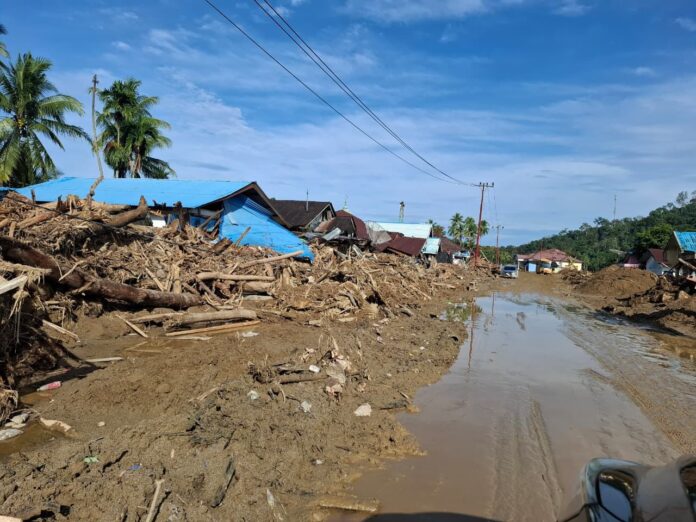
Ecobiz.asia — The Indonesia Environmental Scientist Association (IESA) said a series of environmental disasters throughout 2025 reflect long-standing weaknesses in Indonesia’s natural resource governance, posing a major challenge for President Prabowo Subianto’s administration in 2026.
The statement was delivered by IESA on Saturday (Jan 3, 2026), as part of its policy outlook and evaluation of environmental governance during 2025.
IESA Chairman Yuki Wardhana said hydrometeorological disasters across the country cannot be separated from persistent governance failures, including deforestation, weak law enforcement, and chronic underfunding of environmental management.
IESA identified three core structural problems. First, national development remains heavily dependent on extractive activities without adequate governance safeguards.
Yuki pointed to the limited number of forest rangers tasked with overseeing millions of hectares of forest in Aceh, while budget allocations for environmental and natural resource institutions remain disproportionately low compared to the ecological risks involved.
Second, IESA stressed that disaster impacts extend beyond economic losses to significant human casualties. The association recorded more than 1,000 deaths from major floods in Aceh, North Sumatra, and West Sumatra.
IESA forestry expert Onrizal emphasized the need for criminal and civil law enforcement, including environmental compensation claims against responsible parties, without waiting for disasters to occur.
Third, IESA highlighted weaknesses in disaster management and preparedness. The government was urged to strengthen early risk mitigation through comprehensive disaster vulnerability mapping based on biophysical, social, economic, and cultural data, supported by rigorous field surveys.
Beyond criticism, IESA outlined several policy recommendations. The government was urged to adopt a long-term development strategy focused on strengthening human capital to reduce reliance on natural resource extraction.
IESA warned that delays in this transition risk trapping Indonesia in middle-income stagnation.
IESA also proposed making natural resource rehabilitation—particularly watershed restoration—a key performance indicator (KPI) for relevant ministries.
According to IESA expert Prisca Delima, weak cross-sector coordination and overlapping authorities continue to exacerbate environmental risks rather than reduce them.
In addition, IESA raised concerns over Indonesia’s growing waste management crisis, citing numerous landfills operating beyond capacity.
Local governments were urged to implement mandatory spending for waste management, strengthen waste segregation at source, and ensure integrated waste processing systems from upstream to downstream.
Yuki concluded that failures in natural resource and environmental governance will continue to translate into recurring disasters.
“Improving governance and strengthening human resource capacity are essential to prevent environmental risks from becoming a permanent feature,” he said. ***