

Ecobiz.asia — Carbon standards body Verra has partnered with S&P Global to develop a next-generation carbon registry designed to accelerate credit issuance through the use of live, data-driven systems.
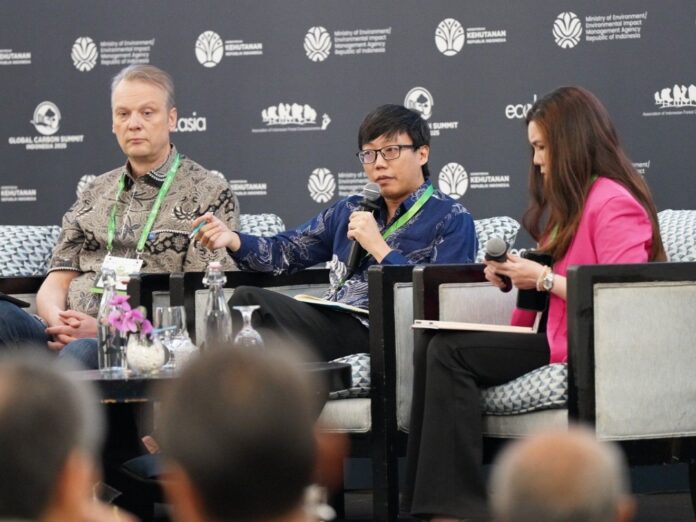
The collaboration was announced by Win Sim Tan, Verra’s regional representative for Asia and the Pacific, during the Global Carbon Summit Indonesia 2025 hosted by Ecobiz Asia in Jakarta on Nov. 26–27. Tan said the new registry is intended to underpin the next phase of global carbon market growth.
“Today, a renewable energy project can take three to four years before credits are issued,” Tan said. “With a new system, that process can become far more dynamic.”
By integrating production and performance data directly into the registry, carbon projects could eventually issue credits on a regular basis, including monthly, depending on data availability.
“If energy production data is directly connected to the registry, credits can be issued whenever the market needs them,” he said.
Verra said the shift would fundamentally change how carbon markets operate, moving away from static, document-based systems toward real-time, data-driven infrastructure. The partnership with S&P Global is expected to strengthen data integrity while improving market confidence.
Beyond renewable energy, Verra is exploring whether similar approaches can be applied to forestry and land-use projects by using satellite imagery, remote sensing and carbon stock modelling.
“If the data quality and modelling are strong enough, this could be a game changer, particularly for land-based projects,” Tan said.
Verra said the registry innovation is particularly relevant for countries with large carbon mitigation potential, including Indonesia, which is expanding its national carbon market framework and seeking to increase the supply of high-integrity credits.
The collaboration with S&P Global forms part of Verra’s broader structural transformation, aimed at ensuring that carbon market growth is supported by systems that are credible, transparent and capable of handling rising demand.
“The carbon market is no longer just growing — it is changing,” Tan said. “And that change requires more advanced infrastructure.”
Verra said the next-generation registry is expected to help the global carbon market scale more quickly without compromising integrity, which it described as essential to investor confidence and long-term climate goals. ***