

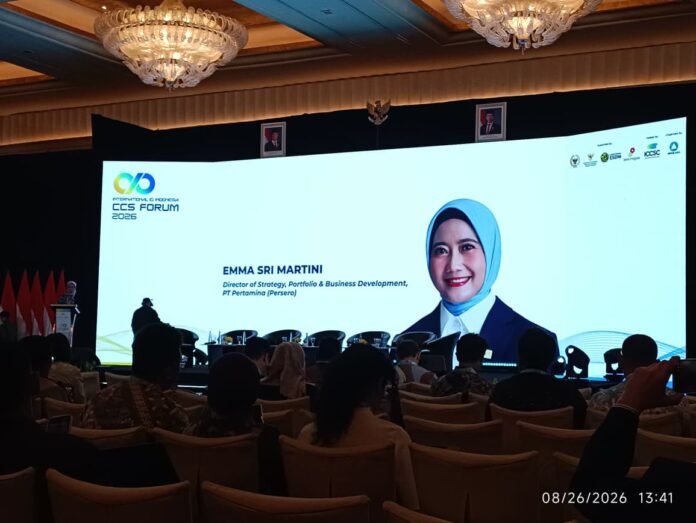
Ecobiz.asia — State-owned oil and gas company PT Pertamina (Persero) has identified around 13 locations across Indonesia for potential carbon capture and storage (CCS) and carbon capture, utilization and storage (CCUS) development as part of its efforts to build a domestic and regional CCS ecosystem.
Emma Sri Martini, Director of Strategy, Portfolio & Business Development of Pertamina, said the studies are currently being conducted across the company’s working areas, covering Sumatra, Java, Kalimantan and Sulawesi.
“For the number, we have already identified around 13 studies which have been initiated and are ongoing, whether it is in Sumatra Island, Java Island, Kalimantan as well as in Sulawesi,” Emma said during the 4th International & Indonesia CCS Forum 2026 in Jakarta on Wednesday (Aug. 26).
She said the studies are part of initiatives that Pertamina has been pursuing for several years. Based on the studies conducted so far, Pertamina has identified around 7.3 gigatons (Gt) of potential CO2 storage capacity across its working areas.
For several projects, Pertamina is working with third parties, including technology providers and technical experts, to bring knowledge, technology and international best practices while mitigating project risks.
The partnerships are also aimed at developing project structures that can secure government support and generate broader economic benefits for the state, including through additional oil and gas production and lifting as well as fiscal contributions in the short, medium and long term.
Emma emphasized that CCS projects would not be commercially viable without appropriate commercial enablers, particularly mechanisms to reduce the cost of CCS infrastructure. One of the approaches being considered is the development of regional CCS hubs that allow multiple carbon emitters to share infrastructure.
“To reduce CCS unit cost, sharing infrastructure is one way of mitigating the risk. A regional CCS hub is becoming one of the solutions, so all parties, all the carbon emitters, can share the infrastructure,” she said. Pertamina, she added, is positioned to become an anchor for Indonesia’s domestic CCS ecosystem given its extensive portfolio of oil and gas working areas across the country.
The CCS ecosystem is expected to involve participation from multiple industries, which could improve the commercial viability of CCS hubs by aggregating CO2 sources and sharing infrastructure. Emma said source clustering would also enable CCS development to be implemented in phases based on regional clusters. “This CCS ecosystem is supposed to involve multi-industry participation and improve CCS hub commercial viability,” she said.
Government Support Key to Commercial Viability
Emma stressed that conducive regulations and government support would be critical to ensuring CCS projects become commercially viable. She said government support is needed not only through regulations but also through fiscal and sectoral policies. “Clearly, it is not going to happen without a conducive environment and support from the government,” she said.
For cross-border CCS hubs, she said regulatory frameworks between participating countries also need to be synchronized. Such synchronization should cover business models, regulatory frameworks, market appetite, monitoring, reporting and verification (MRV), accounting standards, permitting and licensing. “If we are talking about a regional hub for CCS, then we have to align the business model, the regulatory framework, the appetite, the MRV and accounting standards,” Emma said. She also called for more streamlined permitting and licensing processes to accelerate CCS project development.
According to Emma, the issue is not unique to Indonesia, as permitting and licensing can be a lengthy process in many countries. However, governments need to find ways to make the process more efficient in order to accelerate project implementation.
Asri Basin CCS Hub
Emma cited Pertamina’s Asri Basin CCS hub as one example of the company’s efforts to develop a multi-party CCS ecosystem. The Asri Basin CCS hub is being developed to accommodate CO2 from various sources, including domestic emitters, regional emitters and potential future industrial clusters. The project will also utilize Pertamina’s subholding capabilities to manage parts of the domestic CCS supply chain.
However, Emma said a comprehensive framework is still required to unlock the full potential of the CCS hub. She highlighted the need for regulatory synchronization among countries that could potentially use the same regional CCS hub, as well as bilateral and multilateral frameworks to support cross-border CO2 transportation and storage.
The project will also require anchor commitments from emitters, followed by appraisal and front-end engineering and design (FEED) activities, supported by appropriate fiscal terms and government assistance. “The anchor commitments are supposed to be put in place in the first place, and appraisal and FEED will involve government support, fiscal terms and central support, and then something to do with the economic viability of the project itself,” Emma said.
The final step, she added, would be the investment decision, after which the project could potentially be expanded to a regional scale. Emma said all of these components need to be consolidated into an integrated business and cooperation model to ensure CCS projects are executable and capable of attracting financing.
“Last but not least is the determination of business and cooperation schemes for CCS projects. It is related to project financing and how we can come up with a business model that will make the project viable and get it executed,” she said. ***