

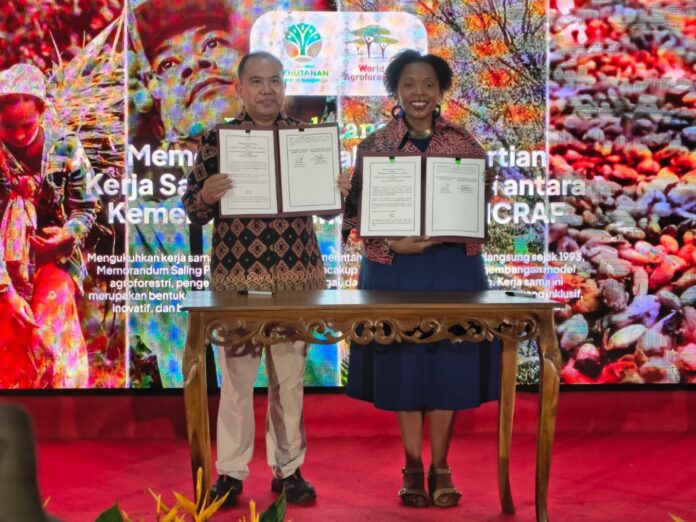
Ecobiz.asia — Indonesia’s Ministry of Forestry has renewed its strategic cooperation with the International Centre for Research in Agroforestry (ICRAF) to accelerate the implementation of agroforestry in sustainable forest and landscape management across the country.
The renewed partnership was formalised through the signing of a memorandum of understanding (MoU) by Forestry Ministry Secretary-General Mahfudz and ICRAF Director General Eliane Ubalijoro in Jakarta on Thursday (March 5, 2026).
The cooperation covers six priority areas: agroforestry model development; watershed management and landscape restoration; innovative financing schemes for agroforestry; agroforestry development in Kawasan Hutan dengan Tujuan Khusus (KHDTK); digitalisation and knowledge management; and strengthening community socio-economic resilience through social forestry programmes.
Mahfudz said agroforestry represents a practical approach to balancing ecological and economic functions in forest landscapes.
“Our 2025–2029 strategic plan envisions forest areas as landscape units that deliver ecological, economic, and social benefits. Forests must serve as productive and sustainable living spaces—not only protected areas but also sources of tangible benefits for communities,” he said.
According to Mahfudz, agroforestry systems integrating forestry species with agricultural crops can increase vegetation cover, improve soil fertility, and contribute to national carbon stock enhancement. The approach is also considered relevant in addressing climate change challenges and rising hydrometeorological disaster risks.
The Forestry Ministry expects the partnership to be translated into concrete field-level programmes while strengthening sustainable forest-based business models for communities living around forest areas.
ICRAF Director General Eliane Ubalijoro noted that agroforestry practices have long existed across communities worldwide, even before the term gained scientific recognition in the 1970s.
She highlighted several traditional Indonesian agroforestry systems that have been practiced for generations, including Repong Damar, Tembawang, Mamar, Pelak, and Parak.
“Through this MoU, ICRAF aims to support Indonesia’s vision of Indonesia Emas 2045. Agroforestry offers an important solution at the intersection of food, energy, and water needs while strengthening landscape resilience to climate change,” Ubalijoro said.
She added that agroforestry development could strengthen management of around 8 million hectares of forest areas currently managed by communities and potentially expand to 12 million hectares, benefiting approximately 1.4 million households across Indonesia. ***