

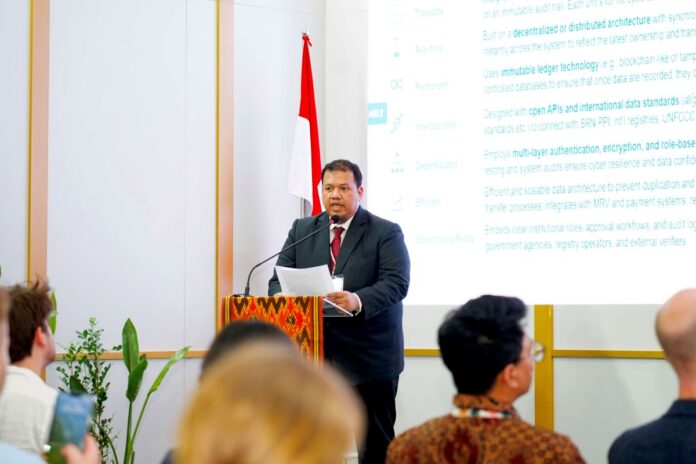
Ecobiz.asia — Indonesia is moving to finalise ministerial regulations under Presidential Regulation (PR) 110/2025 as the foundation for developing a high-integrity forest carbon market aligned with international standards.
Ilham, Director of Forest Utilisation Business Development at the Ministry of Forestry, said the regulation is nearing completion but remains open for input from global stakeholders to ensure full alignment with international methodologies.
“Before the regulation is released, we want all stakeholders, including international partners, to provide feedback,” he said during a keynote speech at a session titled “Navigating Indonesia’s Carbon Market: Challenges, Opportunities and the Road Ahead” at the Indonesia Pavilion during COP30 UNFCCC in Belém, Saturday (Nov. 15, 2025).
Ilham said the ministry is mandated to ensure that all forest carbon projects meet strict quality principles, beginning from project design documents (PDD), the application of universal principles in line with international standards, and strengthened assurance mechanisms that are integrated with licensing processes.
He emphasised the importance of fair benefit-sharing with communities and the need to safeguard biodiversity and the environment to prevent social and tenure-related conflicts in carbon projects.
Speaking in the same session, Andrea Bonzanni, International Policy Director at the International Emissions Trading Association (IETA), said Indonesia has the potential to become a major force in all segments of the global carbon market. He noted that the voluntary carbon market has undergone a major shift in recent years, with demand increasingly focused on high-quality credits.
“Project developers must focus on generating high-quality, high-integrity credits,” Bonzanni said.
Amazon’s Head of Carbon Neutralization Science and Strategy, Jamey Mulligan, also underscored the need for high-quality supply. He said Amazon has committed to achieving net-zero emissions by 2040 under its Climate Pledge, launched in 2019.
That commitment includes decarbonising emissions across the company’s value chain and using high-quality carbon credits to balance residual emissions that cannot be abated. ***