
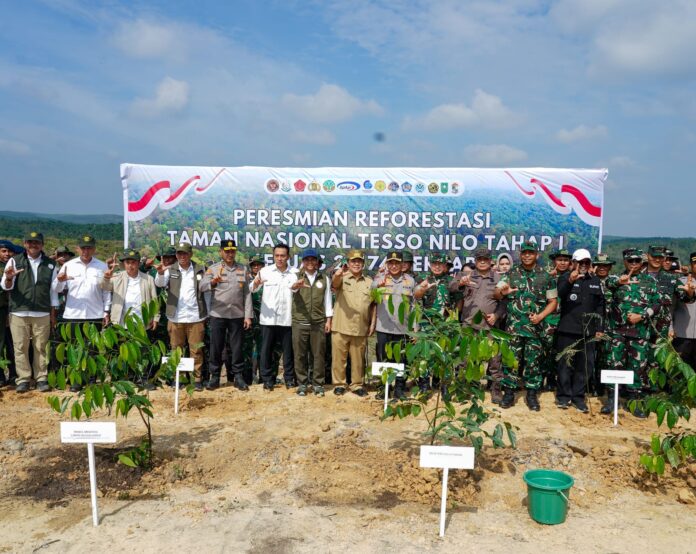
Ecobiz.asia — The Indonesian government has officially launched a large-scale reforestation programme at Tesso Nilo National Park, Riau Province, as part of efforts to restore degraded forest ecosystems and protect critical wildlife habitats.
The programme was inaugurated on Tuesday (March 3, 2026) by Forestry Minister Raja Juli Antoni, who said the recovery of Tesso Nilo has become a national priority due to its high ecological value.
“We can no longer delay restoration efforts. Tesso Nilo is a vital habitat for the Sumatran elephant and many other species. If we fail to act now, we risk the future of central Sumatra’s ecosystem,” Raja Juli said at the launch.
The reforestation initiative follows the government’s policy to reclaim and restore forest areas that have faced prolonged pressure from land-use conversion. Authorities plan to gradually remove illegal oil palm plantations and replace them with native forest species with high ecological value.
In the initial phase in 2026, restoration will focus on 2,574 hectares. The total recovery target is set at 66,704 hectares by 2028. At the launch site, initial planting was carried out on around 400 hectares of former oil palm land, involving 2,000 forest seedlings.
According to the minister, the programme is based on scientific assessments involving research institutions and academics to ensure that selected plant species support wildlife habitat and food availability.
“This restoration is built on a strong scientific foundation. We are ensuring that the planted species provide ecological functions, serving as food sources and shelter for wildlife, particularly the Sumatran elephant,” he said.
Beyond ecological measures, the government is also strengthening governance through law enforcement, a restorative justice approach, gradual and persuasive community relocation, and efforts to clarify land status to ensure areas are legally clear and clean.
Raja Juli stressed that the success of the reforestation programme will depend not only on government action but also on cross-sector collaboration and community participation.
“This reforestation is not just about planting trees. It is a collective commitment to restoring ecological balance and ensuring that future generations inherit sustainable forests,” he said. ***