
Ecobiz.asia – Indonesia and Japan are developing carbon accounting methodologies for forestry projects under their Joint Crediting Mechanism (JCM), focusing on forests, peatlands and mangroves to establish clear standards for projects and ensure compliance with national and international requirements.
The cooperation is intended not only to generate carbon credits but also to promote low-carbon technologies and mobilise sustainable investment for emissions reduction in Indonesia’s forestry sector, said Laksmi Wijayanti, Director General of Sustainable Forest Management at Indonesia’s Ministry of Forestry.
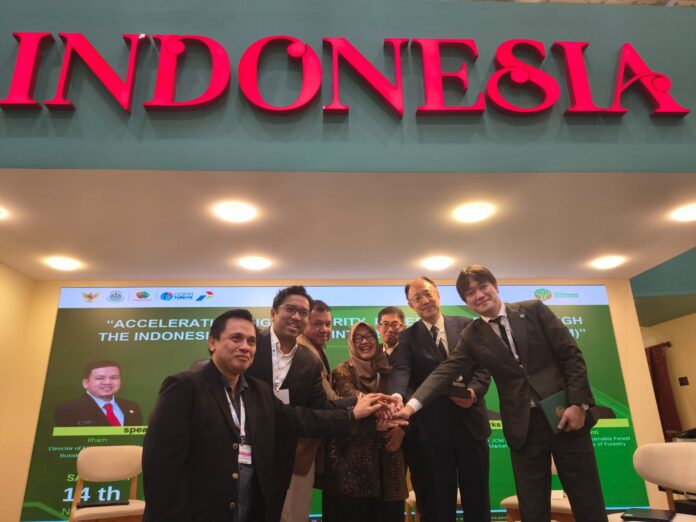
Speaking at a dialogue titled “Accelerating High Integrity Forest Carbon Through the Indonesia-Japan Joint Crediting Mechanism” at the Indonesia Pavilion during the 31st UN Climate Change Conference (COP31) in Antalya, Türkiye, on Saturday (Nov. 14, 2026) Laksmi said the partnership reflected both countries’ commitment to climate action through technology cooperation and investment.
The JCM’s international mitigation target is estimated to reach a cumulative 100 million tonnes of carbon dioxide by fiscal year 2030, she said. Through the bilateral mechanism, Indonesia and Japan aim to expand low-carbon technology deployment and emissions reduction activities in the forestry sector.
Laksmi stressed that approval under the JCM would not replace permits and other authorisations required under Indonesian law. The Ministry of Forestry would retain its regulatory, supervisory and technical responsibilities for forestry activities.
“Approval of JCM methodologies, project registration, and the allocation and issuance of credits through this bilateral mechanism do not replace any permits, approvals, recommendations, registrations, authorisations or other government decisions required under Indonesian laws and regulations,” she said.
International carbon trading authorisations, management of the national registry and emissions accounting adjustments, known as corresponding adjustments, will remain under the authority of government agencies designated in accordance with Presidential Regulation No. 110/2025.
To support the process, the ministry is establishing a methodology development panel comprising four working groups covering forests on mineral soils, peatlands, mangroves and socioeconomic aspects.
Laksmi said the methodologies would need to be grounded in scientific studies and aligned with Indonesian regulations and the existing JCM framework. Potential project activities include reducing emissions from deforestation and forest degradation (REDD+), plantation development, forest rehabilitation, and peatland and mangrove protection and restoration.
Ilham, Director of Forest Utilisation Business Development at the Ministry of Forestry, identified peatlands and mangroves as two ecosystems with significant potential for JCM projects.
Indonesia has approximately 13.36 million hectares of peatland and 3.46 million hectares of mangroves, of which around 2.73 million hectares are within forest areas, he said.
Modelling indicates that peatland management measures, including maintaining wet conditions, preventing degradation and controlling fires, could reduce emissions by up to 960 million tonnes of carbon dioxide equivalent (CO2e) annually by 2030. Mangrove protection and restoration could deliver mitigation potential of up to 41 million tonnes of CO2e per year.
Together, the two ecosystems account for around 77% of the mitigation potential identified across nine nature-based climate solutions assessed in the modelling. The figures represent estimated maximum potential, not carbon credits already issued or immediately available for trading under the JCM.
Ilham said project development would still require appropriate emissions accounting methodologies, robust measurement and verification systems, and environmental and social safeguards. These measures would be needed to ensure that emissions reductions could be measured and verified before being recognised as carbon credits.
From Japan, Kotaro Shimizu, deputy director general of the Forestry Agency at the Ministry of Agriculture, Forestry and Fisheries, said the two countries were working on JCM guidelines for the forestry and peatland sectors. Japan also hoped to expand cooperation into other areas, including mangrove projects.
“To accelerate this work and support the early implementation of the JCM in the forestry sector, the Japanese government plans to dispatch a JICA expert to Indonesia’s Ministry of Forestry in the spring of next year,” Shimizu said.
He said the expert deployment was expected to strengthen bilateral cooperation and help finalise the guidelines and advance subsequent JCM projects.
Toru Terai, director for international strategy at Japan’s Ministry of the Environment, explained that JCM implementation was overseen by a Joint Committee comprising representatives from both governments. The committee makes key decisions, including assessing project proposals, approving emissions accounting methodologies, registering projects and issuing carbon credits.
Under the mechanism, project developers are responsible for measuring and reporting emissions reductions, which are then verified by independent entities. Reductions are calculated by comparing project emissions with the estimated emissions that would have occurred without the project. Only reductions that meet the applicable accounting requirements can generate credits.
Credits are allocated according to each party’s contribution to a project. Some may be transferred to Japan, while others remain with Indonesia. For credits transferred to Japan, the two countries apply authorisation and corresponding adjustments under Article 6 of the Paris Agreement to prevent the same emissions reductions from being counted towards both countries’ climate targets.
Terai said revenue from JCM credits could help cover the additional costs of adopting low-carbon technologies, which are often more expensive than conventional alternatives. For Indonesia, the revenue could help finance emissions reduction projects and support national climate targets, while Japanese companies could gain investment and business opportunities.
As of Oct. 28, 2026, Japan had established JCM partnerships with 32 countries and developed more than 300 projects. Indonesia was among its largest partner countries, with 67 projects.
Japanese companies have also shown growing interest in JCM projects in agriculture, particularly those using Alternate Wetting and Drying (AWD) irrigation methods, as well as in the forestry sector. ***