
By Diah Suradiredja (Expert on Sustainable Commodity Trade)
Ecobiz.asia – The European Union is set to implement the European Union Deforestation-Free Regulation (EUDR) by the end of December 2025. While the regulation stems from a noble intention to curb global deforestation and strengthen climate action, it poses serious challenges for developing countries like Indonesia.
Three crucial aspects demand attention: the benchmarking system, due diligence requirements including geolocation, and proof of legal ownership between farmers and land. These requirements risk excluding millions of smallholders from global supply chains. For Indonesia—one of the world’s largest suppliers of palm oil, coffee, cocoa, and rubber—the stakes are not just economic or fiscal, but also social stability, rural livelihoods, and the achievement of the SDGs.
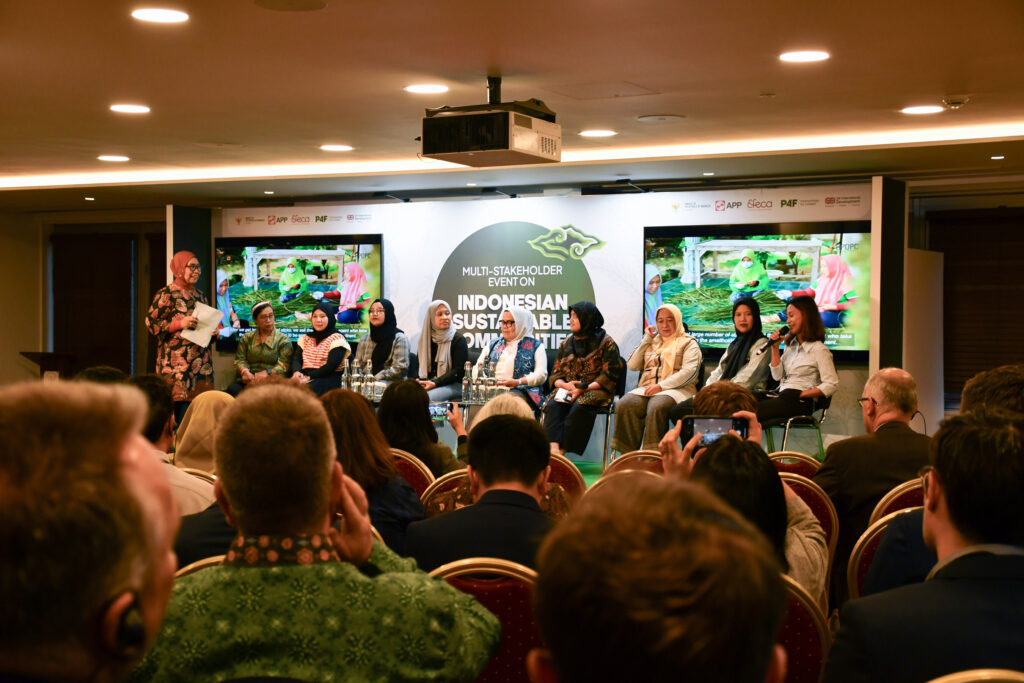
In response, the Indonesian Ministry of Foreign Affairs organized the Indonesian Smallholders Roadshow in Brussels, London, and Rome, initiated by Vice Minister Arief Havas Oegroseno. Through this program, women smallholders—those most affected by EUDR—were given the rare opportunity to speak directly with European policymakers and commodity buyers.
From 13 to 21 September 2025, nine Indonesian women smallholders traveled from remote villages in Sumatra, Java, Sulawesi, and West Papua to engage with international forums. They were not diplomats or officials, but farmers managing on average one to two hectares of coffee, cocoa, rubber, and palm oil. Their mission was simple yet strategic: to deliver the voices of smallholders, especially women, to decision-makers in Europe regarding EUDR implementation.
Why This Journey Matters
Their journey was far more than ceremonial. It carried the weight of Indonesia’s future in global trade and the survival of rural livelihoods. Palm oil, coffee, cocoa, and rubber are not only Indonesia’s key export commodities to the EU but also the backbone of millions of rural families.
Indonesia produced around 47 million tons of crude palm oil (CPO) in 2023, with the EU importing an average of 3.5 million tons annually—making it one of the largest markets. Notably, over 40 percent of national palm oil production comes from smallholders.
In coffee, Indonesia exported about 102,000 tons of green beans to the EU in 2022, almost entirely cultivated by smallholders managing 1–2 hectares each. Specialty Arabica from Aceh and West Java has become a premium product in European cafés.
Cocoa smallholders, especially in Sulawesi, Bali, and West Papua, contribute significantly to Indonesia’s position as a top global producer. In Bali, the Kerta Semaya Samaniya Cooperative (KSS) once exported 55 tons of fermented cocoa annually to France, the Netherlands, and Japan.
For rubber, 1,100 farmers in Jambi cultivate 2,200 hectares of smallholdings, supplying raw material for global industries producing tires, medical gloves, and footwear consumed in Europe.
These numbers underscore a clear reality: smallholders are central actors in global supply chains, yet they are also the most vulnerable to exclusion under EUDR. The regulation demands highly technical compliance—polygon maps, precise geolocation, land legality proof, and extensive due diligence documentation. For smallholders, this translates into high costs and complex processes beyond their reach. Without concrete support, millions risk being shut out of European markets.
The risks are tangible: Indonesia’s strategic exports could be disrupted, rural economies could collapse, and efforts toward sustainability might backfire as smallholders lose the incentive to farm responsibly, resorting instead to cheaper, environmentally harmful practices.
This is why the women’s journey carried such weight. They were not merely presenting data, but the human faces behind global commodities. They reminded policymakers that behind every drop of palm oil, every coffee bean, every cocoa nib, and every drop of latex lies the labor of rural women whose resilience sustains entire families. Their message was both simple and powerful: forest protection must not come at the expense of smallholders.
Why Women Smallholders?
Focusing on women smallholders was no coincidence. They represent the often invisible backbone of global supply chains. In their daily lives, they cultivate, maintain, harvest, and process crops; they lead and manage cooperatives; and at home, they sustain families, ensuring children’s education and household welfare.
Women are also guardians of sustainable practices. With care and patience, they grow coffee under shade trees, sun-dry cocoa beans, produce organic fertilizer for palm oil, and tap rubber without damaging the trees. These practices are not simply about meeting market standards but about preserving land and forests for future generations.
Yet, women’s voices are rarely heard in international policymaking. Global diplomacy has long been dominated by statistics, export data, and technical jargon. By bringing authentic narratives, these women added emotional depth and strategic weight to Indonesia’s diplomacy. Their stories spoke not in technocratic terms, but in lived realities that made sustainability more human and harder to ignore.
As one farmer told a Rome audience: “We may be small, but we exist. Without us, there will be no sustainable coffee, cocoa, palm oil, or rubber.”
What Did They Convey?
In Brussels, London, and Rome, the women repeated a central message: the voices of smallholders must not be erased from global policy.
They shared stories of palm oil plots sustaining children’s education, of coffee grown under forest canopies enriching European cafés, of hand-fermented cocoa beans winning global awards, and of rubber tapped in remote villages supplying industries across the globe.
But they also warned that compliance obligations—polygon maps, GPS coordinates, land certificates—were “high walls” impossible to climb without support. “If this regulation comes without assistance,” they said, “we will be excluded not because we destroy forests, but because we cannot meet the paperwork.”
They posed sharp questions: Will European buyers share the costs of compliance, or push them onto smallholders? Will national certifications like ISPO or agroforestry practices be recognized, or dismissed in favor of costly new systems? And does sustainability mean only protecting trees, without protecting the women and families who depend on them?
Responses from the EU, Industry, and Civil Society
EU officials stressed that EUDR is final and cannot be revised. Their focus now is on fair implementation so that smallholders are not victimized: “The EUDR is here, and there’s nothing we can do to revise it. Our task is to ensure smallholders don’t suffer,” one EU representative said. Legally, due diligence falls on importers, not farmers. But smallholders fear, with good reason, that the burden will cascade down supply chains and ultimately land on their shoulders.
European industry associations expressed concern that overburdening smallholders could disrupt supply continuity. In London, some buyers opened the door to “shared responsibility,” signaling willingness to co-finance mapping, certification, and traceability systems—a hopeful step toward more equitable supply chains.
International NGOs and academics went further, warning against “green protectionism.” They argued that sustainability cannot be defined solely by environmental metrics, but must also integrate social and economic justice. If regulations exclude smallholders, they said, global supply chains will lose the very people who safeguard forests in practice. Some called for permanent multi-stakeholder platforms to ensure smallholder voices remain embedded in global sustainability frameworks.
Media coverage amplified the message. Agenzianova highlighted how Indonesian women brought human stories to a technical debate, evoking European public sympathy. Euroactive reported Indonesia’s call for EU technical and financial support to help smallholders adapt, warning that without it, rural producers risk losing global market access. Across outlets, the narrative shifted: these were not just commodities, but lifelines for rural communities.
The Way Forward
The journey of Indonesian women smallholders to Brussels, London, and Rome demonstrated that diplomacy is not the sole domain of officials. Farmers who tap rubber, pick coffee, dry cocoa, and tend palm trees in remote villages can also shape international debates.
They did not come to reject sustainability, but to remind the world that sustainability cannot be achieved by sacrificing smallholders. Every policy, including EUDR, must see the human face behind commodities: women farmers who rise before dawn, work diligently, and dream of a better future for their children.
This story-based diplomacy delivered one clear message: forest protection must go hand in hand with protecting smallholders. Without them—especially women—there can be no sustainable palm oil, coffee, cocoa, or rubber. And without them, there is no fair future for global supply chains.
Their journey is not the end but a beginning—a step toward a more inclusive diplomacy. From villages in the archipelago to global stages, Indonesian women smallholders have shown the world that sustainability is not just about maps and documents, but about people who nurture the earth with love. ***