
Ecobiz.asia — Indonesia has called for stronger regional cooperation in ASEAN to address increasingly complex challenges in chemical and waste management, including the growing risks of cross-border waste movement.
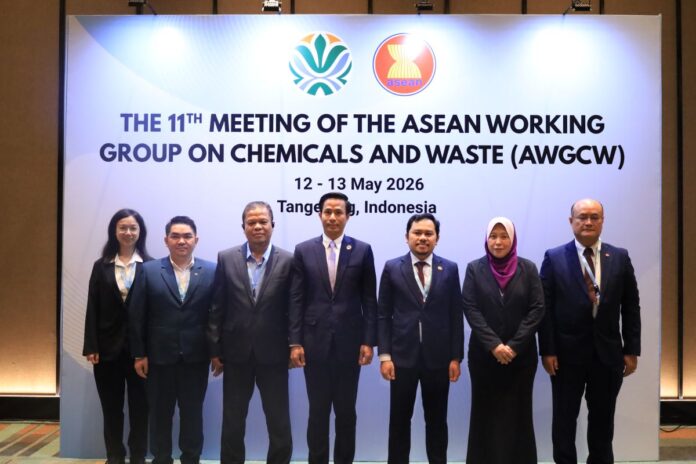
The commitment was highlighted during the 11th Meeting of the ASEAN Working Group on Chemicals and Waste (AWGCW), held on May 12–13, 2026, in Tangerang, Banten.
Acting Deputy for Waste, Hazardous Waste, and Hazardous Substances Management at Indonesia’s Ministry of Environment and Environmental Control Agency, Laksmi Widyajayanti, said chemical and waste management can no longer be viewed solely as a national responsibility.
“Sound management of chemicals and waste can no longer be regarded merely as a national task, but must become a collective global movement. Without international cooperation, it will be impossible to combat illegal cross-border waste trafficking and realize a circular economy in this region,” Laksmi said in a statement on Wednesday (May 13, 2026).
AWGCW Chair from Malaysia, Mahadi Bin Sukarno, stressed that ASEAN must not become a destination for global waste dumping amid the region’s rapid economic growth.
“As a rapidly developing region, ASEAN must not become a global waste dumping ground. This meeting is important to align policy directions so we can balance economic progress with environmental protection and public health. We must ensure ASEAN remains free from chemical and waste pollution through concrete action, not merely annual meetings,” Mahadi said.
During the two-day meeting, Indonesia’s Ministry of Environment facilitated discussions on seven priority programs under the AWGCW Action Plan, including the adoption of environmentally friendly technologies for green industries, emergency response mechanisms for chemical accidents, and remediation of contaminated land.
Indonesia also pushed for harmonized operational standards among member states to strengthen regional preparedness in implementing international environmental agreements, including the Basel Convention, Minamata Convention on Mercury, and the Montreal Protocol.
The forum also served as a platform for exchanging circular economy innovations, focusing on waste management approaches that not only reduce environmental impacts but also create sustainable economic value.
The outcomes of the meeting will help guide Laos, which is set to assume the AWGCW chairmanship in 2027.
The meeting was attended by delegates from Brunei Darussalam, Cambodia, Indonesia, Malaysia, Myanmar, Laos, Philippines, Singapore, Thailand, Vietnam, Timor-Leste, and the Association of Southeast Asian Nations Secretariat.
International partners participating in the forum included the Asian Institute of Technology, the Embassies of Denmark and Finland, and the Economic Research Institute for ASEAN and East Asia. ***