

Ecobiz.asia — The Indonesian government is laying the groundwork for biodiversity credits as a new financing instrument to strengthen conservation efforts and environmental management. The initiative will draw on lessons from international mechanisms, including the Paris Agreement.
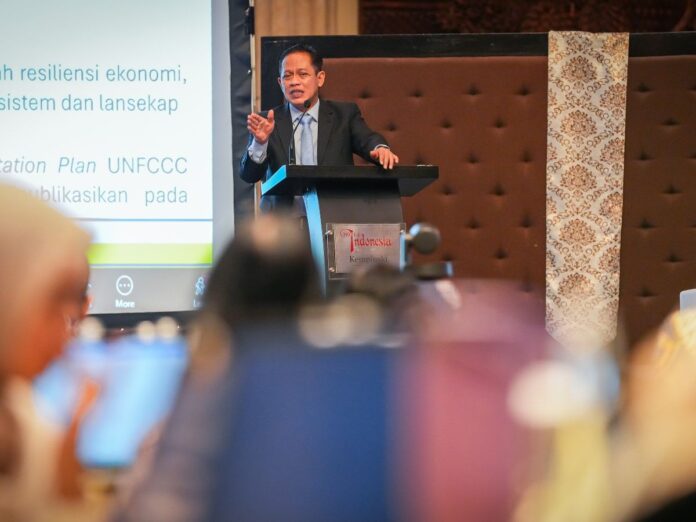
“We are taking serious steps to elevate biodiversity management into a biodiversity credit scheme, learning from both the strengths and weaknesses of global mechanisms,” Environment Minister Hanif Faisol Nurofiq said during a briefing on Indonesia’s COP30 outcomes in Jakarta on Tuesday (Dec 2, 2025).
As an initial step, Indonesia signed several memorandums of understanding on the sidelines of COP30 in Belém, Brazil. One of them was a Letter of Intent between the Ministry of Environment and The Royal Foundation of The Prince and Princess of Wales, covering biodiversity conservation, sustainable development, the prevention of illegal wildlife trade, and environmental crime.
The government also signed an MoU with the UK Department for Energy Security and Net Zero, aimed at expanding cooperation on climate mitigation and adaptation, carbon governance, and low-carbon development.
At COP30, Indonesia additionally launched its Blue Carbon Ecosystem Roadmap and Action Guideline, designed to enhance coastal protection, restoration, and management in support of a climate-resilient, low-carbon ocean economy.
Hanif emphasized that these partnerships strengthen Indonesia’s efforts to meet international climate obligations, including the submission of its Second Nationally Determined Contribution (NDC) and the National Adaptation Plan to the UNFCCC Secretariat.
He noted that such commitments demonstrate the strong foundation underpinning Indonesia’s carbon market development and carbon economic value governance. “Indonesia is not rushing. We are confident because we are building this on solid foundations,” he said.
Hanif stressed that credibility in both carbon markets and biodiversity credits cannot be built overnight. “Credibility isn’t formed through one or two statements—or in one or two years. It requires evidence and a consistent track record.”
He added that Indonesia’s growing credibility is reflected in mutual recognition arrangements (MRA) established with global carbon standards, a key step ahead of the full implementation of Article 6 of the Paris Agreement, which requires authorization from the host country for carbon transfers. “These are part of the diplomatic steps we are taking,” he said. ***