
Ecobiz.asia — Cross-sector collaboration is seen as essential to accelerating tropical forest regeneration and strengthening local community empowerment as part of global climate action efforts.
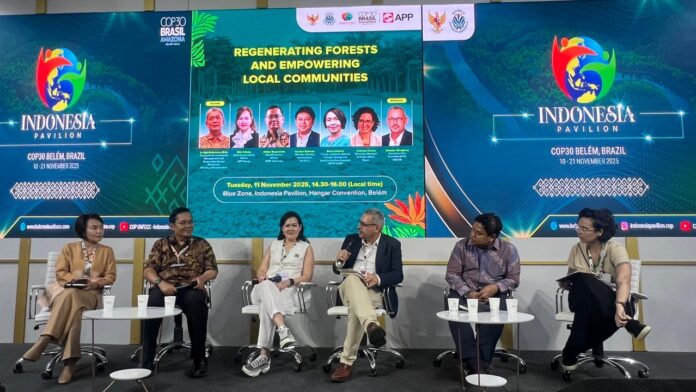
This message emerged during a dialogue titled “Regenerating Forests and Empowering Local Communities” held at the Indonesia Pavilion during the COP30 UNFCCC Climate Conference in Belém, Brazil, on Tuesday (Nov. 11, 2025).
The discussion brought together representatives from APP Group, WWF Indonesia, GenZero, and CIFOR–ICRAF to explore strategies for enhancing forest ecosystem resilience and improving the livelihoods of communities dependent on forest landscapes.
The session was moderated by Dominic Waughray, Executive Vice President of the World Business Council for Sustainable Development, and featured panelists including APP Group Chief Sustainability Officer Elim Sritaba, WWF Indonesia CEO Aditya Bayunanda, GenZero Policy & Analytics representative Anshari Rahman, and CIFOR–ICRAF Theme Leader for Climate Change, Energy, and Low Carbon Development Beria Leimona.
APP Group, representing the private sector, outlined long-term models for forest management and community partnership. The panel also noted the contrast between short-term financial and market cycles and the long-term, intergenerational timelines of ecosystems and Indigenous communities.
Panelists underscored the need for integrated frameworks aligning economic and environmental goals, supported by innovative financing mechanisms and inclusive governance to strengthen Indonesia’s contribution to forest-based climate solutions.
“Indonesia’s forests play a vital role in environmental resilience while supporting economic development. Through our Forest Positive Policy under the Regenesis platform, we aim to ensure business growth aligns with real benefits for communities and the climate,” Elim Sritaba said.
APP Group stated that it has allocated US$30 million annually over the next 10 years to support landscape restoration, biodiversity improvement, and community empowerment across its operational areas.
WWF Indonesia’s Aditya Bayunanda emphasized the importance of ensuring that private-sector initiatives genuinely address community needs. He noted that areas with critical habitats, high biodiversity, and key ecosystem services including water and cultural values must remain priorities for protection.
CIFOR–ICRAF’s Beria Leimona highlighted the need to balance scientific approaches with social relevance. She stressed that involving communities in decision-making processes is crucial to ensuring legitimacy and long-term sustainability of forest initiatives. ***