
Ecobiz.asia — Indonesia highlighted its large-scale mangrove rehabilitation program as a model for nature-based climate solutions at the COP30 UN climate conference, emphasizing the need for innovative financing to sustain long-term ecosystem restoration.
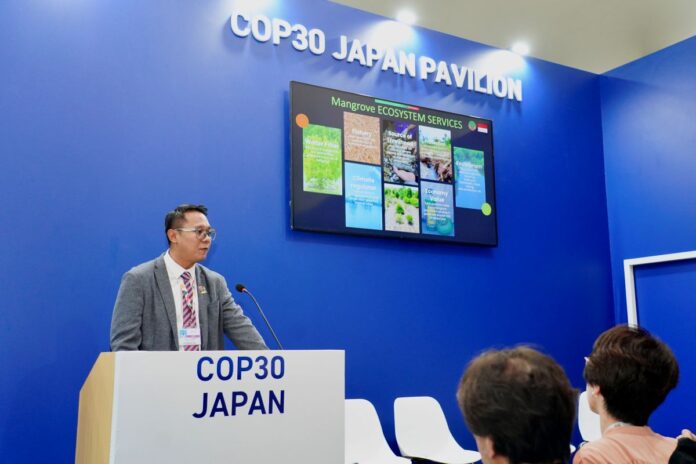
Speaking at a session hosted by the Japan International Cooperation Agency (JICA) at the Japan Pavilion, Thursday (Nov. 13, 2025), Ristianto Pribadi, Director of Mangrove Rehabilitation at the Ministry of Forestry, outlined Indonesia’s progress as the world’s largest mangrove holder.
With 3.44 million hectares, about 23% of global mangrove ecosystems, Indonesia sees both ecological responsibility and economic opportunity in restoring coastal ecosystems.
Ristianto said mangrove forests offer high ecological and economic value, citing their ability to filter water and support coastal ecosystems.
“Two to five hectares of mangroves can naturally filter the pollution generated by one hectare of aquaculture ponds,” he said.
Mangroves also store three to five times more carbon than terrestrial tropical forests and provide coastal protection at a cost up to five times cheaper than hard infrastructure.
They serve as habitat for more than 3,000 fish species and support food security and livelihoods for millions of coastal residents.
He noted that conventional funding models are often insufficient for large-scale mangrove rehabilitation. Indonesia is promoting innovative finance, combining blended funding, climate finance instruments, and philanthropy to enable rapid deployment of resources, multi-year flexibility, performance-based financing, and direct community access.
Ristianto said long-term adaptive financing of five to seven years is essential, along with multi-stakeholder governance, community-aligned economic development, science-based adaptive management, land-tenure clarity, and global knowledge-sharing networks.
Indonesia’s approach relies on collaboration among key groups: government regulators, international partners, local communities, research institutions, and NGOs.
“These efforts show that mangrove restoration can function as a strategic climate investment, one that delivers ecological impact, economic resilience, and social inclusion,” he said. ***