
From Pumped Storage to Green Corridors, KfW Maps Indonesia’s €3.04 Billion Energy Projects Through 2029

MORE ARTICLES

Ecobiz.asia – Germany’s KfW Development Bank is preparing an energy financing pipeline in Indonesia that could reach €3.04 billion (Rp62.9 trillion) through 2029, covering projects ranging from pumped storage and hydropower rehabilitation to geothermal development, renewable energy and transmission infrastructure.

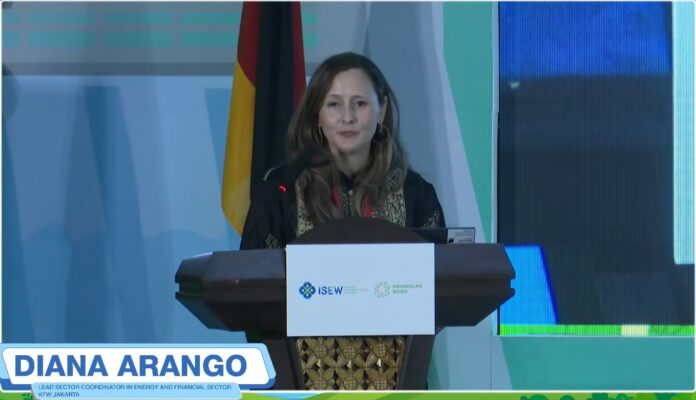
Diana Arango, Lead Coordinator for the Energy Sector at KfW Development Bank, presented the financing portfolio during Indonesia Sustainable Energy Week (ISEW) 2026 in Jakarta on Wednesday (August 19, 2026).

KfW currently has an energy portfolio worth around €1.6 billion (Rp33.1 trillion) in Indonesia. Its pipeline through 2029 includes new generation projects as well as grid infrastructure and policy programs to support the country’s energy transition.

Read also:  VCarboN Eyes Compliance Carbon Markets, Seeks to Expand Indonesian Projects into South Korea

The planned projects provide a broader picture of where German development financing could be directed in Indonesia over the next several years, including hydropower, geothermal, solar and wind power, as well as electricity transmission.

In the hydropower sector, KfW’s existing portfolio includes projects in Kumbih, Sawangan and Bakaru, as well as the 1,000 Islands Renewable Energy Electrification Programme.

The next phase of financing includes two pumped storage projects and the rehabilitation of 25 hydropower plants. KfW’s presentation did not disclose the capacity, location or individual financing value of the two pumped storage projects.

KfW is also preparing additional financing for geothermal development. Its existing portfolio covers geothermal projects in Kamojang, Ulumbu and Mataloko, while Candi Umbul Telemoyo is included in the future pipeline.

Read also:  Indonesia, Australia Boost Forest Governance Cooperation at APEC Meeting

The bank is also planning the second phase of the Accelerating Indonesia’s Clean Energy Transition program, which will support solar and wind power development.

Transmission infrastructure is another major component of KfW’s cooperation with Indonesia. The bank currently supports grid development in Sulawesi and Nusa Tenggara, the Sustainable and Reliable Energy Access Program, and the Green Energy Corridor Sulawesi.

A second phase of the Green Energy Corridor Sulawesi is included in KfW’s pipeline through 2029, underscoring the importance of grid development in integrating renewable energy into Indonesia’s power system.

Read also:  Indonesia-Germany Energy Cooperation Maps €2.3 Billion Project Portfolio, Sulawesi Green Corridor Takes Shape

The financing pipeline also includes policy support. KfW lists the Sustainable and Inclusive Energy Program and the Affordable Sustainable Energy Transition (ASET) program among its ongoing activities, with a second phase of ASET planned.

KfW can provide financial cooperation through several instruments, including policy-based loans to support regulatory reforms, direct investment financing for infrastructure projects, result-based loans linked to agreed outcomes, and grants for project preparation and implementation.

The portfolio reflects the broadening scope of Indonesia-Germany energy cooperation, extending beyond renewable power generation to include grid infrastructure, energy policy and the integration of higher shares of renewable energy into Indonesia’s electricity system. ***


LATEST STORIES

MORE ARTICLES

IESR: Solar-Battery Hybrids Could Cut Indonesia’s Diesel Costs by Rp17.2 Trillion

Ecobiz.asia – Replacing diesel-fired power generation with solar photovoltaic (PV) systems and battery energy storage could save Indonesia up to Rp17.2 trillion, while creating...

PwC: Indonesia’s RUPTL Could Unlock US$116.3 Billion in Power Generation Investment Through 2034

Ecobiz.asia – Indonesia’s 2025–2034 Electricity Supply Business Plan (RUPTL) could unlock around US$116.3 billion (Rp2,100 trillion) in power generation investment through 2034, with renewable...

APAMSI: Indonesia’s Solar Manufacturing Capacity Reaches 10.9 GW, Demand Remains the Bottleneck

Ecobiz.asia – Indonesia has 34 operating solar module factories with combined annual production capacity of 10.9 GW, but manufacturers are facing a demand gap...

AESI: PLN’s Giga One Tender Brings 1,225 MW of Solar Capacity to Market

Ecobiz.asia – Indonesia’s utility-scale solar market is beginning to see larger procurement volumes, with 1,225 MW of solar capacity being offered through PLN’s Giga...

Indonesia-Germany Energy Cooperation Maps €2.3 Billion Project Portfolio, Sulawesi Green Corridor Takes Shape

Ecobiz.asia – Indonesia and Germany are implementing and preparing a broad portfolio of energy projects with a combined committed budget of €2.3 billion (Rp47.6...

TOP STORIES

PGN Gagas Perluas Akses Gas Bumi di Yogya Lewat Skema CNG

Ecobiz.asia -- Keterbatasan jaringan pipa gas bumi mendorong PT Perusahaan Gas Negara Tbk (PGN) melalui anak usahanya PT Gagas Energi Indonesia (PGN Gagas) memperluas...

PGN Dorong Pemanfaatan Jargas sebagai Penggerak Ekonomi Masyarakat Sleman

Ecobiz.asia -- PT Perusahaan Gas Negara Tbk (PGN) terus mengoptimalkan pemanfaatan jaringan gas bumi (jargas) di Sleman, Yogyakarta, tidak hanya untuk memenuhi kebutuhan rumah...

IESR: Solar-Battery Hybrids Could Cut Indonesia’s Diesel Costs by Rp17.2 Trillion

Ecobiz.asia – Replacing diesel-fired power generation with solar photovoltaic (PV) systems and battery energy storage could save Indonesia up to Rp17.2 trillion, while creating...

PwC: Indonesia’s RUPTL Could Unlock US$116.3 Billion in Power Generation Investment Through 2034

Ecobiz.asia – Indonesia’s 2025–2034 Electricity Supply Business Plan (RUPTL) could unlock around US$116.3 billion (Rp2,100 trillion) in power generation investment through 2034, with renewable...

APAMSI: Indonesia’s Solar Manufacturing Capacity Reaches 10.9 GW, Demand Remains the Bottleneck

Ecobiz.asia – Indonesia has 34 operating solar module factories with combined annual production capacity of 10.9 GW, but manufacturers are facing a demand gap...