
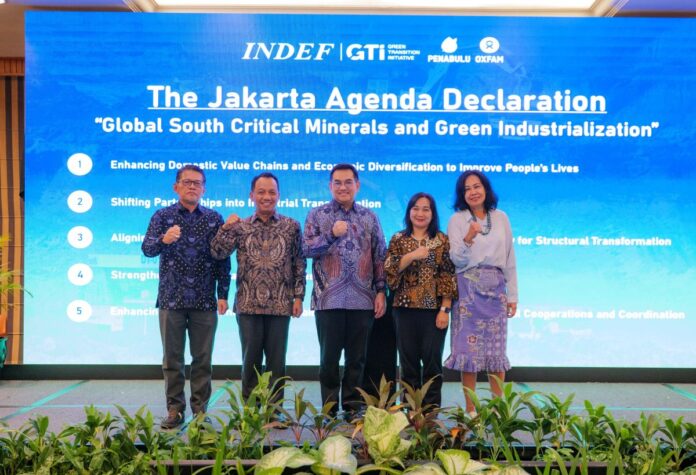
Ecobiz.asia – Countries across the Global South have called for stronger cooperation to increase domestic value creation from critical minerals and develop more sustainable green industries, with the call set out in the Jakarta Agenda adopted at the Critical Minerals & Green Industrialization for Shared Prosperity in the Global South forum in Jakarta on Thursday (Aug. 13, 2026).
The agenda calls on critical-mineral-producing countries in the Global South to develop regional value chains, strengthen industrial capacity and ensure that a greater share of the economic benefits from natural resources is retained domestically.
Indonesia’s Director General of Mineral and Coal Tri Winarno said resource-producing countries in the Global South need to build strategic partnerships to prevent the development of mineral processing industries from taking place in isolation.
“Indonesia is ready to be an equal partner in building value-added and responsible critical minerals value chains that deliver prosperity across the Global South,” Tri said.
He said Indonesia’s experience in developing downstream industries for nickel and copper could provide lessons for other resource-producing countries. However, critical minerals development must also be accompanied by environmental and occupational safety standards as well as product traceability.
Deputy for Strategic Investment and Downstreaming at the Indonesia Investment Coordinating Board (BKPM) Heldy Satrya Putera said critical minerals development should focus on building integrated industrial ecosystems that combine industrial policy with green principles.
“Our focus is not simply on processing raw commodities, but on building a competitive industrial ecosystem by integrating industrial policy with green principles,” Heldy said.
The proposed cooperation covers investment partnerships, technology collaboration, alignment of production standards and efforts to strengthen manufacturing capacity among countries in Asia, Africa, Latin America and the Middle East. The approach is intended to strengthen the position of Global South countries in global critical minerals supply chains.
INDEF Executive Director Esther Sri Astuti said rising demand for critical minerals presents a major opportunity for resource-rich Global South countries, but producers should avoid remaining primarily suppliers of raw materials to global industries.
“Critical minerals must become a foundation for building our own industries and creating decent jobs for our people,” Esther said.
The Jakarta Agenda was developed through a collaboration between the INDEF Green Transition Initiative and the Penabulu-Oxfam Foundation, bringing together representatives from Asia, Africa and Latin America to discuss the future of critical minerals and green industrialization.
Penabulu Foundation Program Director Rini Devianti Nasution said the Jakarta Agenda identifies five priorities: strengthening domestic value chains and economic diversification; shifting partnerships toward industrial transformation; aligning policies across sectors and countries; strengthening accountability throughout value chains; and building industrial capacity through South-South cooperation.
“Through the Jakarta Agenda, the voices of countries in the Global South are strengthened in advocating for critical minerals governance that puts industrial transformation, sustainability, inclusiveness and shared prosperity at the heart of the global energy transition,” Rini said.
The agenda emphasizes sustainability and domestic economic benefits as key elements of critical minerals development, with downstreaming extending beyond raw-material processing to manufacturing capacity, job creation and a stronger role for Global South countries in global supply chains. ***