

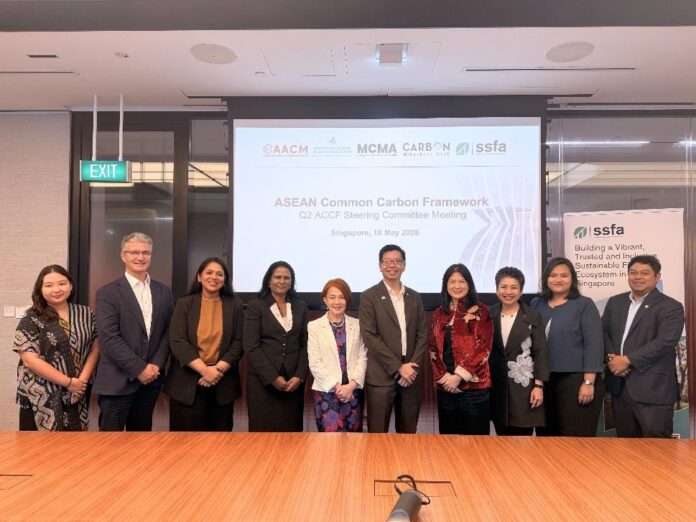
Ecobiz.asia — The ASEAN Common Carbon Framework (ACCF) is accelerating efforts to build interoperable and high-integrity carbon markets across Southeast Asia, as regional industry associations push for practical implementation and stronger cross-border market integration.
According to a press release received on Monday (May 18, 2026), ACCF member associations convened in Singapore during Ecosperity Week 2026 for the ACCF Steering Committee meeting to advance regional coordination on carbon market development.
The ACCF is an industry-led initiative aimed at supporting the development of integrated and interoperable carbon markets across ASEAN. The framework focuses on three key pillars: supply and demand development, market infrastructure, and strategic communications and capacity building, supported by policy alignment and pilot carbon transactions.
Developed jointly by the Indonesia Carbon Trade Association (IDCTA), Malaysia Carbon Market Association (MCMA), Singapore Sustainable Finance Association (SSFA), ASEAN Alliance on Carbon Markets (AACM), and Thailand Carbon Markets Club (TCMC), the framework has gained increasing regional recognition over the past year.
The Indonesia Carbon Trade Association (IDCTA) highlighted ongoing efforts to strengthen project development and market infrastructure, including feasibility studies on transition credits linked to the early retirement of coal-fired power plants and progress in carbon capture and storage (CCS) initiatives.
IDCTA also continues to facilitate market dialogues and international collaboration to support carbon project pipelines, pilot transactions, and cross-border cooperation aimed at scaling the supply of high-integrity carbon credits from the region.
Meanwhile, the Singapore Sustainable Finance Association (SSFA) has developed an “Implementation Guide for Corporate Usage of High-Integrity Carbon Credits,” aligned with Singapore’s national guidance and international frameworks to support consistent carbon market practices across ASEAN.
The Malaysia Carbon Market Association (MCMA) has also supported the development of Malaysia’s National Carbon Market Policy, launched in April 2026, which recognizes the ACCF as a key enabler of regional interoperability.
The Thailand Carbon Markets Club (TCMC) has supported early progress in cross-border market connectivity through its collaboration with the Macao Emission Exchange (MEX), including the first listing of Thai Renewable Energy Certificates (RECs) and T-VER carbon credits on an international platform.
According to the press release, the region’s carbon market architecture is evolving toward interoperability rather than uniformity, enabling different national systems to connect in a credible and efficient manner.
Looking ahead, the framework will continue prioritizing pilot transactions, policy harmonization, and capacity building to strengthen trust in ASEAN-origin carbon credits and facilitate broader cross-border collaboration. ***